NIST Technical Series Publications
NIST Special Publication (SP) NIST SP 1181-2025
NIST Special Publication (SP) NIST SP 1181-2025
Unit Pricing Guide
“A Best Practice Approach to Unit Pricing”
John T. McGuire
David A. Sefcik
Isabel Chavez Baucom
Katrice A. Lippa
Office of Weights and Measures (OWM), Physical Measurement Laboratory (PML)
Scott Dolan
Vermont Agency of Agriculture, Food and Markets
This publication is available free of charge
June 2025
Abstract
This guide was developed to provide retailers with information about the best practice requirements for the unit pricing of commodities. The guide consists of best practice approaches that will improve the accuracy and usability of unit pricing information offered. The Best Practice Guide encourages uniformity and implementation of weights and measures best practices for unit pricing across all states and use in all types of retail store formats including E-commerce sites.
It was developed to assist industry in the practice of providing unit price information as a voluntary provision where no legislative requirements or standards exist. Where legislative requirements and standards do exist, this guide can be used to provide unit pricing that supplements and complements those requirements.
The Best Practice Guide is made available online for use by anyone interested in improving the presentation of unit pricing information. This guide was built upon the existing Uniform Unit Pricing Regulation in NIST Handbook 130, “Uniform Laws and Regulations in the Areas of Legal Metrology and Engine Fuel Quality” and considered the 16 states with current unit pricing regulations to achieve and promote a more comprehensive, consumer friendly and uniform approach to unit pricing.
Disclaimer
Certain commercial equipment, instruments, or products are identified in this paper in order to specify the experimental procedure adequately. Such identification is not intended to imply recommendation or endorsement by the National Institute of Standards and Technology, nor is it intended to imply that the products or equipment identified are necessarily the best available for the purpose.
NIST Technical Series Policies
Copyright, Fair Use, and Licensing Statements
NIST Technical Series Publication Identifier Syntax
Publication History
Approved by the NIST Editorial Review Board on 2025-06-23.
Supersedes NIST Spec. Pub. 1181-2015 (December 2014) https://dx.doi.org/10.6028/NIST.SP.1181
CODEN: NIHAE2
How to Cite this NIST Technical Series Publication
McGuire JT, Sefcik DA, Dolan S, Baucom ICh, and Lippa KA, (2025). Unit Pricing Guide. “A Best Practice Approach to Unit Pricing” (National Institute of Standards and Technology, Gaithersburg, MD), NIST Special Publication (SP) NIST SP 1181-2025. https://doi.org/10.6028/NIST.SP.1181e2025
NIST Author ORCID iDs
JT McGuire: 0009-0006-7396-155X
DA Sefcik: 0000-0001-7407-1950
Scott Dolan: 0009-0006-9616-6137
ICh Baucom: 0009-0004-8989-2021
KA Lippa: 0000-0001-8651-8326
Contact Information
NIST Office of Weights and Measures
100 Bureau Drive, MS 2600
Gaithersburg, MD 20899
Keywords Unit Price, Pricing, shelf label, signs, best practices, guide, ESL, Electronic Shelf Label, E-commerce, advertisement.
Executive Summary
This guide was developed to provide retailers with information about the best practices for unit pricing of commodities. It consists of best practice recommendations that will improve the accuracy and usability of unit pricing information offered in retail stores or e-commerce. In addition, the guide will help provide uniformity across all states and types of stores.
Many retailers in the various retail channels voluntarily provide unit pricing in their stores. This guide's purpose is to assist retailers in understanding consumer preferences regarding presentation, units of measure used, consistency, and accuracy.
The best practices in this guide can be used in any retail environment, including supermarkets, drug and convenience stores, mass merchandisers, wholesale clubs, auto parts stores, department stores, e-commerce or virtually anywhere products are sold where units of measure (e.g., weight, volume, length, area, count) can be used to compare prices and values. It applies to both food and non-food products. When unit pricing, every effort should be made, as applicable, to provide unit pricing across the store, the store’s online presence, and the store’s customer-facing applications for any given product category. Unit pricing is helpful in that it displays the price of all brands and sizes of commodities for a product category per the same unit of measure (e.g., price per kilogram, liter, pound, fluid ounce).
In addition, the guide enables the use of unit pricing in either the metric system (International System of Units [SI]) or U.S. customary. Some examples of categories where the use of metric units may be more appropriate or beneficial than the U.S. customary system include wine, distilled spirits, bottled beverages, and spices.
This guide was developed to assist the industry in providing unit price information as a voluntary provision where no legislative requirements or standards exist. Where legislative requirements and standards do exist, this guide can be used to provide unit pricing that supplements and complements those requirements.
Factors that most improve the readability and usability of a unit price label include using the “blocked approach” while utilizing the largest font size possible. When used in combination with other attributes such as bold text, color background, clarifying terms (e.g., providing the words “unit price”), and location of the unit price, maximum readability and usability can be achieved.
This guide is not intended to conflict with the Uniform Unit Pricing Regulation (UUPR) or state unit pricing regulations. When providing unit pricing in a state or territory under the UUPR or mandatory state regulations, the UUPR or mandatory regulations should be consulted to ensure those requirements are met before the recommended best practice requirements in this guide are implemented.
Unit Pricing Best Practices Workgroup History
In July 2011, a technical session was held at the National Conference on Weights and Measures (NCWM)1 Annual Meeting to highlight and address the opportunities to improve unit pricing. This led to the formation of a NIST OWM collaborative work group in March 2012, whose mission was to develop best practice guidelines for industry to improve the accuracy and usability of unit pricing information provided by retailers. The work group members included representatives from industry, trade associations, academia, weights and measures regulatory officials, consumer groups, consumer advocates, and the National Institute of Standards and Technology (NIST).
The workgroup's goal was to develop an industry best practice guide for unit pricing that will be made available online for anyone interested in improving the presentation and accuracy of unit pricing information. This guide was built upon the existing UUPR in NIST Handbook 130, Uniform Laws and Regulations in the Areas of Legal Metrology and Engine Fuel Quality and took into account current States’ mandatory unit pricing regulations in an effort to achieve and promote a more comprehensive, consumer-friendly, and uniform approach to unit pricing.
In July 2024, the Unit Price workgroup was reconvened to review and update the guide, including making recommendations for unit pricing best practices in the online environment and addressing electronic shelf labels in conventional retail stores. The objectives of the workgroup were:
-
To reduce variation in the presentation of unit price information as it is presented by retailers.
-
To improve the usability of unit price information by making it easy to identify, read, understand, and use.
-
To develop best practice standards that will improve the accuracy and uniformity of unit price information available to consumers and that will be supported by industry in its adoption and use.
-
To include best practices for unit pricing on e-commerce sites and to provide recommendations for Unit Pricing on electronic shelf labels/displays (ESL).
-
To incorporate the NIST Handbook 130 Section G. Uniform E-commerce Regulation.
The Unit Pricing Guide “A Best Practice Approach to Unit Pricing” was updated in June 2025.
Acknowledgements
The NIST Office of Weights and Measures (OWM) wishes to thank each organization and representative of the workgroup for their time, dedication, and expertise in providing input and reviewing drafts of this guide. They include:
Trade Associations
FMI, The Food Industry Association (FMI)
Consumers Groups
Consumer Reports
Consumer World
National Consumers League (NCL)
Queensland Consumers Association (Australia)
Weights and Measures Officials
California, Division of Measurement Standards
Connecticut Department of Consumer Protection
Hawaii Quality Assurance Division – Measurement Standards Branch
Massachusetts Division of Standards
New Jersey Office of Weights and Measures
Vermont Agency of Agriculture, Food & Markets
Academia
Queensland University of Technology (QUT) Business School
Independent
CGGT Resources (Chris Guay, Guay Technologies)
Manufacturers
VusionGroup Inc.
Retailers
Wakefern Food Corporation
Walmart
Background
Unit pricing has been in existence in the U.S.A. since the early 1970s, growing out of the “truth-in-labeling” era. Consumers demanded more information (“right to know”) on labels to make informed purchase decisions. Many methods of unit pricing were explored, including stamping the unit price on the product, posting the unit price on large signs by category, and giving consumers a calculator and pen to allow them to compute it themselves. The current method of putting unit price information on shelf labels and other in-store price signs was chosen because it is the easiest for the consumer to use and for retailers to maintain.
Unit pricing came into being about the same time the Fair Packaging and Labeling Act (FPLA) was enacted, which was in 1966. Before the FPLA was passed, there was considerable discussion about requiring and limiting the package sizes sold. Manufacturers and retailers opposed having size restrictions and instead suggested the idea of providing a unit price. As a result, the requirement to limit package sizes never became part of the FPLA.
In addition, supermarket point-of-sale scanners started to become widely used in the early 1970s, which led to an exploration of ways to provide a better alternative to individual item (sticker) pricing. Most states allowed retailers to be exempted from item pricing requirements if they provided unit pricing. At the same time, private-label brands were also gaining attention. Unit pricing was a visible way for a retailer to show the value provided by their house brand.
For a variety of reasons, including a lack of voluntary requirements, several states in the northeast region developed mandatory legislation for unit pricing. Over the years, multiple states have adopted legislation that either requires unit pricing or have set standards for any voluntary implementation.
In 1979, The National Conference on Weights and Measures (NCWM) developed and adopted the UUPR, the first ever model regulation that states can adopt as their own or use as a guide in developing their own state regulations. It was further amended in 1997.
More recent innovations in retail sales, such as electronic shelf labels that utilize interactive devices such as QR codes, online advertising and sales, and related sales for pick up or delivery, and prices posted on applications that can be individualized to specific consumers, require new ways to inform consumers. Relatedly, evolutions in the retail marketplace that have blurred the lines between traditional categories, with grocery, hardware, and even clothing stores offering products once exclusively sold by other categories of retailers, have expanded the range of retailers concerned with disclosing unit prices.
Unit pricing is one of the most effective tools available to consumers to facilitate value and price comparison. This is especially important in settings where products are sold at differing price points in various pack sizes that can otherwise be difficult to directly compare. It is helpful in today’s economy and in an environment where “downsizing” of packages is prevalent. Package downsizing is known as “shrinkflation.” Research indicates consumers view this negatively, particularly if it appears to be done without transparency.2 Unit pricing aids consumers in evaluating the comparative value of any given product, even when changes in package size occur. For more information on Shrinkflation, visit NIST OWM.
Consumers should use unit pricing to make informed decisions about price and value comparisons for the products they are purchasing. Retailers also benefit when unit price labeling best practices are implemented through improved pricing accuracy and greater inventory control, which ultimately reduces labor costs for the retailer.
The Purpose of this Guide
Voluntary use of unit pricing by retailers is highly recommended because of its value to consumers and businesses (see “Benefits of Unit Pricing” on page 9). It is one of the best tools a consumer can have during their shopping experience to help them make value and price comparisons. FMI The Food Industry Association3 reported in its U.S. Grocery Shopper Trends 2023 that 74% of shoppers use Unit Pricing in a store when it is available. Providing unit pricing is in the spirit of the Fair Packaging and Labeling Act (FPLA), which states:
“Informed consumers are essential to the fair and efficient functioning of a free market economy. Packages and their labels should enable consumers to obtain accurate information as to the quantity of the contents and should facilitate value comparison. Therefore, it is hereby declared to be the policy of the Congress to assist consumers and manufacturers in reaching these goals in the marketing of consumer goods.”
The development of this guide has considered several existing resources. These include: the existing state mandatory unit pricing regulations,4 The Uniform Unit Price Regulation from NIST Handbook 130,5 research and surveys done by Consumer Reports,6 The National Consumers League,7 The Australian Queensland Consumers Association, a Canadian Report on Unit Pricing,8 researchers at Michigan State University and the University of South Australia, and the knowledge and expertise of the Unit Pricing Best Practices Workgroup (see participants listed under the Acknowledgements).
Definitions
Unit Pricing
Unit pricing is the cost per unit of measure of products, such as the cost per milliliter or per ounce. In the past, unit pricing information was most commonly displayed on in-store shelf labels and/or signs. Unit pricing information can be displayed anywhere products are marketed, including brick-and-mortar stores, online, on websites, in streaming environments, in mobile applications, etc.
Electronic Shelf Label (ESL)
An ESL is an electronic display that retailers can use to present a product's name, price, unit price, and other information on a small wired or wireless panel, usually on the edge of a store shelf.
E-Commerce
E-commerce is the process of offering for sale, transacting sales, and delivering consumer product(s) or non-consumer product(s) when the purchaser is not physically present at the point of purchase. It includes online sales made using websites and phone applications, catalog sales, and sales transacted via online marketplaces by third parties when the purchaser is not physically present.
Shrinkflation
Shrinkflation is the reduction of a product's net contents without a commensurate reduction in price. The downsized product may be in similar packaging. The effect of shrinkflation is to increase the product's unit price.
Opportunities for Improvement
-
Figure 1 shows examples of unit price labels that reflect a widespread lack of uniformity and readability. Opportunities for improvement identified in the design, provision, and maintenance of unit price labels are described below. More uniformity and standardization are needed. Lack of uniformity and standardization (as illustrated in Figure 1) makes it difficult and can be frustrating for consumers to compare the prices and values among products
-
Increased prominence of unit price information (e.g., font size, use of bold type, color coding to distinguish unit price from retail price) is positively associated with consumer awareness and use of unit prices at the store level. The eye is naturally attracted by larger visual elements. Greater consistency from retailer to retailer on the placement and readability of information on shelf labels and signs.
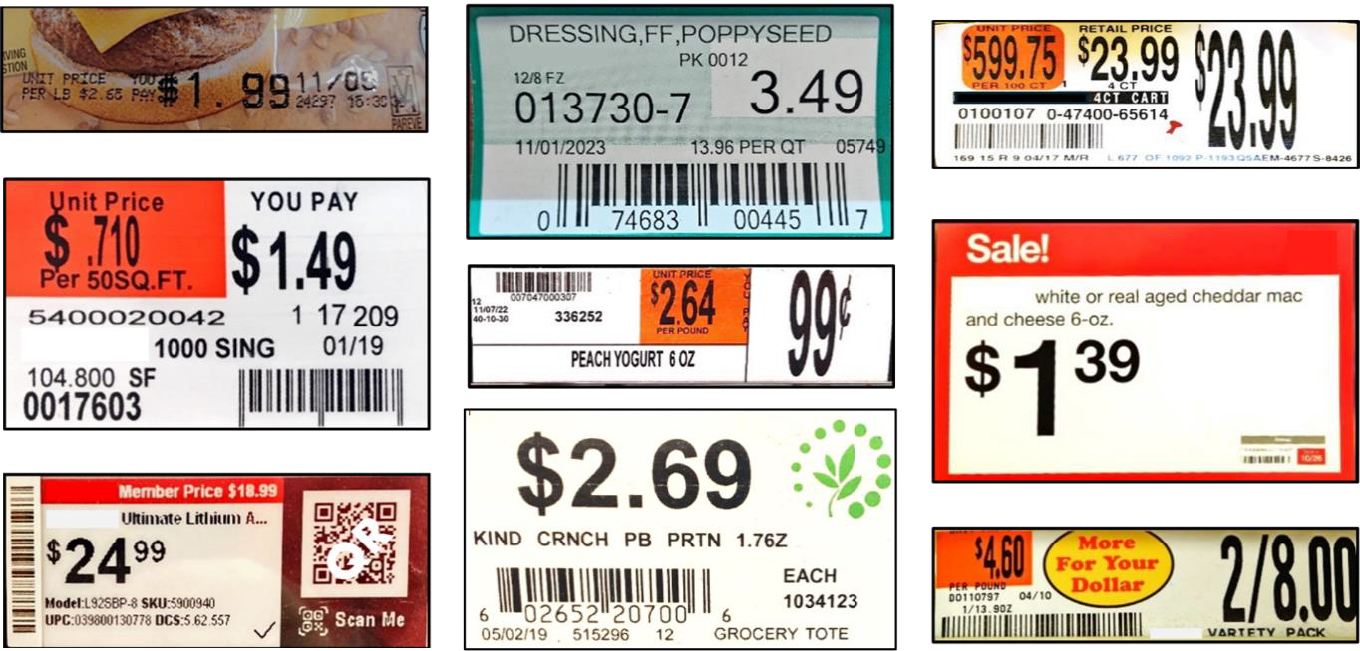
Figure 1 — An assortment of shelf labels that demonstrates the lack of uniformity of unit price labeling in the current marketplace.
-
Better accuracy and consistency in the unit of measure used to designate the unit price across a category (all brands and sizes) of product for price and value comparison.
-
Increased font size and readability.
-
Ensure that the print size used allows the unit price to be read on the bottom shelf labels.
-
Better angle of labels to increase readability.
-
Greater inclusion of unit price information on sale signs.
-
Use of metric unit pricing across appropriate product categories. Retailers are encouraged to look for opportunities to provide metric unit pricing to consumers, especially in product categories where metric is normally used and recognized (e.g., wine, spices, and bottled beverages).
Note: Wine and distilled spirits, for example, under the Alcohol and Tobacco Tax and Trade Bureau, have had a net content requirement for over 30 years that it only be declared in metric units. The marketplace typically uses U.S. customary units in the unit price, where metric units are more appropriate in this product category.
-
Provide unit pricing for more product categories and more store formats, such as convenience and drug stores, auto parts stores, wholesale clubs, mass merchandisers, and online retailers.
-
Ongoing education of consumers on the value and usage of unit pricing.
-
To include technology and the use of Electronic Shelf Labels
If left unaddressed, these opportunities for improvement may undermine consumer confidence, which in turn could diminish the benefits available to both consumers and retailers.
Current Laws and Regulations
There is no federal mandate that requires unit pricing. Unit pricing is voluntary unless mandated by state laws or regulations. Currently, sixteen (16) states and three (3) territories have unit pricing laws or regulations in effect: Arkansas, Connecticut, Florida, Hawaii, Maryland, Massachusetts, Mississippi, Montana, Nevada, New Hampshire, New Jersey, New York, Oregon, Rhode Island, Vermont, West Virginia along with the territories of, the District of Columbia, Puerto Rico and the Virgin Islands (see Figure 2).9 State or territory requirements, if applicable, must be met before the recommended best practice requirements in this guide can be implemented. It is best to contact the state’s Weights and Measures Director10 in the state in which you plan to provide unit pricing to determine if state and/or local requirements apply.
For further information, please review NIST Handbook 13011 II. Uniformity of Laws and Regulations and Summary of State Laws and Regulations in Weights and Measures.
Be sure to check with legal counsel to ensure that any practices adopted from this guide comply with the state or territory laws that apply to the jurisdiction in which business is done.
The UUPR only applies when stores provide unit pricing information. If a company (or store) decides to provide unit pricing in a state that adopts the UUPR, the company (store) is required to meet all the requirements of the UUPR. The UUPR is the best means for providing a uniform national approach to unit pricing. This guide is not intended to conflict with the UUPR or state unit pricing regulations. When providing unit pricing in a state or territory that is under the UUPR or mandatory state regulations, the UUPR or mandatory regulations should be consulted to ensure requirements are met before the recommended best practice requirements in this guide are implemented.
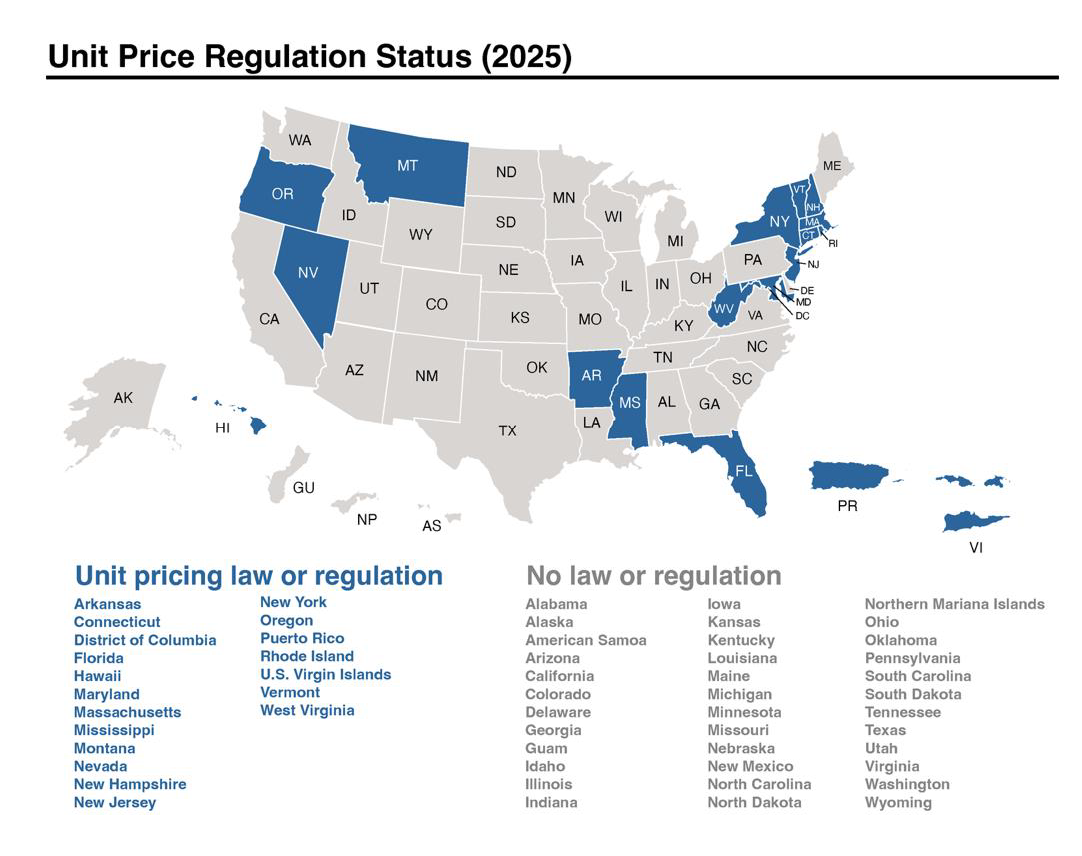
Figure 2 — A map indicating which U.S. States have a unit pricing laws or regulation in effect in 2025.
Benefits of Unit Pricing and Shelf Labels
Consumer Benefits
Unit pricing is one of the best tools available to consumers to facilitate value and price comparison. This is especially important in settings where products are sold at differing price points in various pack sizes that can otherwise be difficult to directly compare. It is helpful in today’s economy and in an environment where shrinkflation is prevalent. Research indicates consumers view this negatively, particularly if it appears to be done without transparency.12 Unit prices can help consumers recognize when this has occurred.
Other benefits for consumers include:
-
Savings on household grocery and related expenditures, or the ability to buy more products. Research shows that when consumers are educated about unit pricing, they can make use of unit prices to make more cost-effective purchases.14 In some instances, this may lead to product upsizing, where buying larger pack sizes is seen as better value, or it may lead to brand switching, where competitor products are seen as cheaper or a better value.13 Findings have shown that consumers may save money on particular purchases, but that they often reinvest those savings into their shopping budget by buying more products, rather than necessarily reducing their overall spend.13
-
Faster and easier purchase decisions. Research shows that unit prices can reduce the cognitive load associated with making purchase decisions, and hence, it can be particularly beneficial for consumers with limited time.14
-
Simpler and more informed purchase decisions for those consumers with lesser numeracy skills, those on tight budgets, or those with low incomes.
-
Greater transparency of pricing, which can lead to higher levels of satisfaction, product evaluation certainty, and increased loyalty to stores.15
Retailer Benefits
Some of the benefits retailers have reported are:
-
Unit pricing offers a means of customer service and satisfaction and improves the shopping experience. There is research that suggests that unit pricing improves a store or retailer’s image and increases shopping intention.15
-
It improves pricing accuracy.
-
Unit pricing promotes and increases sales of private-label products by showing value. Research shows it does not simply drive consumers to the cheapest or lowest-priced product, but instead leads shoppers to consider value13.
-
It provides a tool for stockkeeping and health information.
-
This results in better ordering practices and tighter inventory controls.
-
It enables the promotion of special programs such as Women, Infants, Children (WIC), and displays graphics indicating nutritional information (e.g., ↓ [low] sodium, ↑ [high] fiber).
-
Unit Pricing eliminates the need for individual item price marking when the price is instead disclosed on a shelf label or sign. If not addressed, shortcomings in unit pricing practices may significantly reduce consumers’ confidence in and use of unit pricing, which in turn will reduce the benefits obtained by consumers, retailers, and the economy.
Section 1. Unit Price Label & Sign Design Principles
When designed effectively, unit price labels empower consumers by enabling straightforward price comparisons between products, helping them make better purchasing choices based on value rather than just the total price.
The following principles should guide the decision making on the design and maintenance of unit price labels and signs.
Principles
Legibility
To achieve legibility, the text should be large enough to read easily from normal viewing distances and positions, with a font that contrasts well against the background for visibility. The unit price should be placed near the total price to facilitate quick comparisons, allowing consumers to see both the overall cost and the price per unit at a glance.
Clarity
Unit price labels must be clear, concise, and easy to interpret to help consumers make informed purchasing decisions. Overloading a label with excessive information can confuse rather than assist the shopper. A well-designed label should prioritize essential details, such as the price per unit (e.g., per liter, per kilogram, per ounce), and present this information in a way that is prominent and easy to locate. Additionally, the label should avoid jargon or unnecessary technical terms, keeping the language simple and direct.
Prominence
Information on the label intended for the consumer should be more prominent than information intended for retailer use only.
-
The required information (product identity, net quantity, unit price, and retail price) on a unit price label should be the most prominently displayed. That means the retailer's miscellaneous information (typically the barcode, UPC number, order code) should be less prominent (less conspicuous, smaller font size) in comparison to the required information.
-
All required information should be in bold type and prominently displayed. Secondary (retailer) information should not be bolded.
-
In some cases, such as when state requirements may mandate certain information on a label, such as a WIC logo, or when information such as the barcode (i.e., self-scan) is directly used by consumers, consideration should be made to make this information more prominent.
-
The unit price on the label should not be obscured and should be clearly displayed in a consistent, unambiguous, and legible manner. This means it can be easily seen and read by consumers (including those with restricted sight and mobility) from normal viewing positions and distances while maintaining visibility.
Placement and Contrast
The placement of required and optional information should follow the suggested “graphic alignment principle” or “blocked approach” format as outlined in the next subsection below.
-
The unit price block is often color-coded to distinguish itself from the retail price. The color chosen should provide a clear contrast from the color background used for the rest of the label.
Viewing and Display
Care should be taken to ensure unit price labels and shelf signs are displayed so that all information can be easily seen and read. Viewing angles can greatly influence the noticeability and readability of information. Therefore, great care should be taken to ensure that labels and signs in difficult viewing situations, for example, lower and upper shelves, are angled to assist the reader. Placing labels or signs at vertical or near-vertical positions should be avoided. Care should also be taken to ensure that sign holders and other shelf attachments do not obscure the unit price label. In the case of electronic shelf labels, it is best to choose a type with a wide viewing angle, so that customers viewing labels from the side will see as crisp an image as possible.
Product Identity
Product identity (description) and size (net content) should be stated together. The size can be in metric or U.S. customary units, whichever is most commonly understood by shoppers for that product type. The product identity should include both the product name and brand in a form easily understood by the consumer, especially in cases where abbreviations are used. In the product identity and unit price, a space should separate the actual quantity from the unit; for example, Multi-Grain Cereal is $1.95 per 100 g, not $1.95 per 100g, or 14 oz, not 14oz.
Descriptors
The words “unit price” should be stated above the actual unit price, and the word “per” should be used to link the unit price to the units (e.g., 37.5¢ per liter or quart). The words “retail price” should be stated above the actual selling price. Other words of similar import can be used as long as they are consistent throughout the store (e.g., “you pay”, “total price”).
Accuracy
Retailers should have an audit program to ensure the accuracy of unit pricing, both at the corporate and store levels. This program should verify that the price, the units chosen, and the consistency of units across each product category are correct, as described in Section 5. General Recommendations and Best Practices.
Text
Use of upper and lower case for all text is recommended.16 Studies have shown that the use of all capital letters is more difficult to read.17
Font Size
-
Retail Price – The largest font size possible should be used based on the size of the actual label or sign.
-
Unit Price – The larger the font size of the unit price, the better, but not less than 0.24 inches (6 mm).18 The font size of the unit price should not be less than 50% of the retail price font size on a shelf label.19 On larger sale signs, the unit price font should be at a minimum of 25.4 mm or 1 in, if that can be reasonably accommodated.
Bottom Shelf Labels and Labels Out of Consumer Reach
Consideration should be given to providing larger or angled unit price labels on the bottom shelf and higher labels out of the consumer’s visual reach, as compared to unit price labels on easily accessible shelves. This will allow for larger and bolder fonts to be printed for viewing at greater distances, especially for the lower shelves. Consumers have complained that labels on the bottom shelves are difficult to read due to the viewing distance. Retailers generally will need software that can support “flagging” items merchandised on the bottom shelf so the correct size unit price label can be generated for the store. Using the largest label possible, as well as the largest font size feasible, is important to the consumers’ ability to read bottom shelf labels. For electronic shelf labels that are best viewed straight on, those on a bottom shelf should be angled upwards.
Formatting and Location of Information
Graphic Alignment Principle or “Blocked Approach”
The recommended graphic alignment, or “blocked” approach, is essential for presenting information in a way that ensures consistency, uniformity, clarity, and readability of a unit price label. While the figures shown illustrate the blocked approach, with the retail price on the left and the unit price on the right, these two blocks can be interchanged. Either design is acceptable as long as the retailer maintains consistency in their “blocked approach” to displaying the retail and unit prices throughout the store and/or online.
A unit price label should be divided into four blocks. As illustrated in Figure 3, these four blocks of information are presented in a logical and progressive order. This aligns with the label and sign design principle that “information on the label or sign for the consumer should be more prominent than that for the retailer.”
Labels should not be overloaded with information. A good label draws the eye to relevant information. Font size is critical to the readability, clarity, and prominence of information and should generally be as large as feasibly and technically possible, as the label size would permit.
Color of Font and Background
The “blocked” approach fonts should be in black color with a white background (for contrast) except for the unit price block, which should have a colored background to clearly distinguish itself from the retail price. It is also recommended that Blocks 1, 2, and 3 (containing “required information”) have bold lettering and numbers (see Figure 3). Block 4 is “optional” retailer information and should be less prominent. Therefore, no boldface is recommended. The amount of space devoted to the retail price (Block 2) and the unit price (Block 3) should be equal.
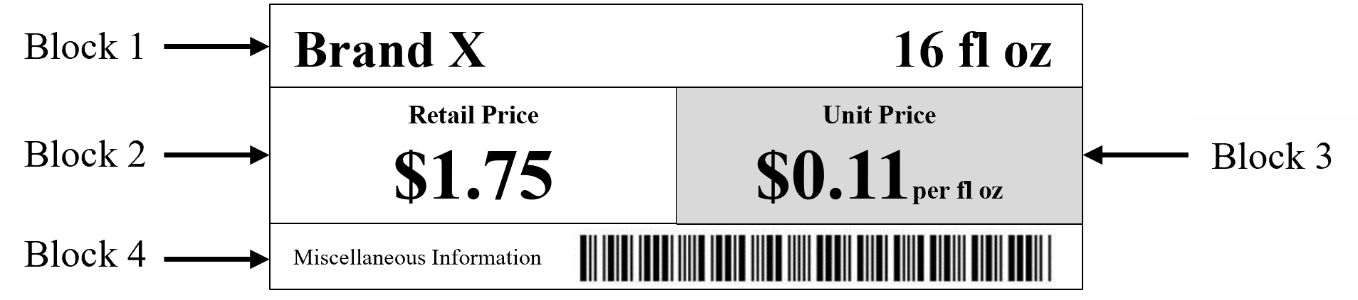
Block 1 is the Product Identity and Size, Block 2 is the Retail Price, Block 3 is the Unit Price, and Block 4 is the Miscellaneous Information.
Figure 3 — An example of a “blocked” approach for the design of a generic unit price shelf label.
Block 1 – Product Identity and Size
-
The product identity and brand name of the product should be accompanied by the size of the package, as shown in Figure 3, Block 1 Product Identity and Size.
-
Abbreviations are acceptable (even recommended due to character limitations, but they should not be so cryptic that the average shopper will have difficulty understanding them, and they should be consistent. It is recommended that the brand name be abbreviated first, and then the product identity can be abbreviated if necessary.
Block 2 – Retail Price
-
The size and conspicuousness of the numerals used to disclose the retail price shall be equal to or greater than that of the unit price as shown by the information provided in Figure 3, Block 2 Retail Price.
-
The term “retail price,” “you pay,” or a similar term should be stated directly above the total retail price.
-
All numerals and text should be in bold font.
-
Background should be plain white.
-
Check states’ mandatory unit pricing regulations to determine if a specific requirement exists on the placement of retail price.
Block 3 – Unit Price
-
The unit price typeface should be as large as possible, but not less than 6 mm or 0.24 in. It should also be at least 50% of the height of the retail price of the largest digit of the retail price, as shown by the information provided in Figure 3, Block 3 Unit Price. Market surveys have shown that the size of the unit price typically exceeds 11 mm on average.13 (Some states have pricing regulations that may specify a different minimum font size requirement.)
-
If the minimum 6 mm cannot be met due to technological barriers or physical limitations, the largest font size possible should be used based on the size of the actual label.
-
The term “per” should be used when defining the unit price (e.g., $1.99 per kg; $1.99 per lb).
-
The term “unit price” should be stated directly above the unit price.
-
All numerals and text should be in bold font.
-
The unit price should have a color background different from the rest of the label to easily distinguish it from the retail price.
-
The color contrast ratio between the text and the background should be greater than or equal to 7:1.20
-
-
Unit price information should appear on both regular price labels and sale tags, including signage used for club card or loyalty card pricing, as shown in Figure 3.
-
Check states’ mandatory unit pricing regulations to determine if a specific requirement exists regarding the placement of the unit price and background color.
Block 4 – Miscellaneous Information – Retailer Specific
-
Information provided here is at the retailer’s discretion. This may include, but is not limited to, a Barcode, Order code, Universal Product Code (UPC), or QR Code as shown in Figure 3, Block 4. Miscellaneous Information.
When designed effectively, unit pricing labels empower consumers by enabling more direct price comparisons between products, helping them make better purchasing choices based on value rather than just the total price.
Another simplified example of a unit price label that utilizes the four “blocked” design in provided in Figure 4, with a detailed explanation of content to be included in each of the four “Blocks”.
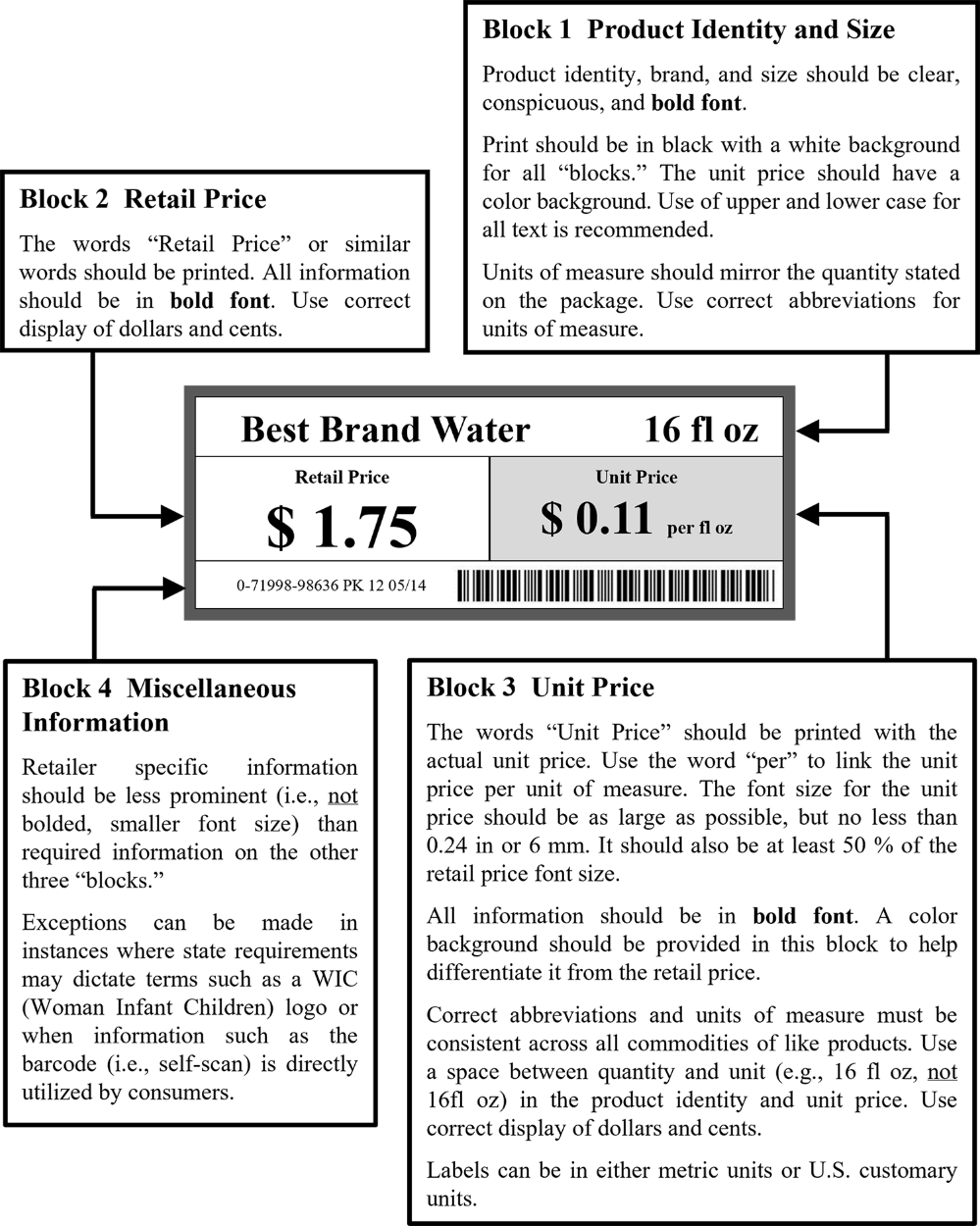
Figure 4 — An example unit price label with a detailed explanation of content to be included in each of the four “blocks”.
Section 2. Units of Measure for Unit Pricing
The display of the unit price of a particular product category in all package sizes offered for sale in a retail establishment or on an e-commerce site should be uniformly and consistently expressed in the terms below. When unit pricing, the same unit of measure should be used whether sold in a pre-pack, loose from bulk, or random weight, regardless of multiple locations within the store or e-commerce sites.
For example, if all packages in a product category are labeled with varying declarations of quantity in a combination of liters and milliliters, a single unit price declaration should be selected (e.g., all items might be unit priced by the liter or all by milliliter). Another example is when all packages in a product category are labeled with quantity declarations in gallons, quarts, pints, and fluid ounces; a single unit price declaration should be chosen (e.g., all items might be unit priced by the quart or all by ounce). The unit price can be expressed in either metric or U.S. customary units. As shown in Figure 5, certain commodities are best labeled with the unit price in metric units.
Use the unit of measure most commonly displayed on packages within the category. For example, if most products in the cereal category use grams or ounces, while a smaller percentage use kilograms or pounds, the best practice would be to use grams or ounces as the unit price, whichever is more commonly understood by consumers for that product category.
Table 1 outlines the only units permissible for unit pricing, depending on how a product is packaged and sold. Table 2 presents the acceptable abbreviations for these units, categorized by method of sale type.
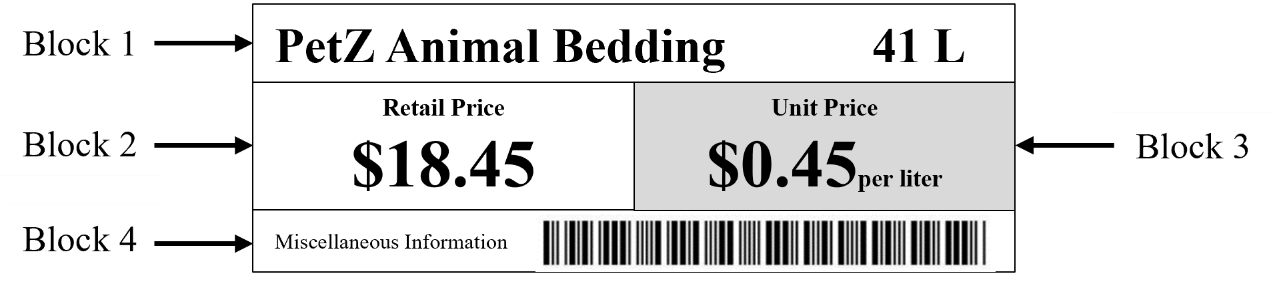
Figure 5 — An example of a “blocked” approach for the design of a generic unit price shelf label using metric units.
Table 1. Terms for Units of Measure
|
Measure |
(SI) Metric Unit |
U.S. Customary Unit |
|
Weight or Drained Weight |
100 grams, kilogram |
ounce, pound |
|
Dry Measure or Volume |
Liter, 100 milliliters, cubic meter, cubic decimeter, cubic centimeter |
dry quart, dry pint*, cubic yard, cubic foot, cubic inch |
|
Liquid Volume |
liter or 100 milliliters |
gallon, quart, pint*, fluid ounce |
|
Count |
piece, count, each |
piece, count, each |
|
Area |
square meter, square decimeter, square centimeter |
square yard, 100 square feet, square foot, square inch |
|
Length |
meter, decimeter, centimeter |
yard, foot, inch or 100 feet |
|
* 1 liquid pint = 1.1636478… dry pints |
||
Table 2. Abbreviations for U.S. Customary and SI Units
|
Liquid Volume |
Weight or Drained Weight |
|||
|
Units |
Abbreviation |
Units |
Abbreviation |
|
|
liter |
L or l |
kilogram |
kg |
|
|
milliliter |
mL or ml |
gram |
g |
|
|
gallon |
gal |
pound |
lb |
|
|
quart |
qt |
ounce |
oz |
|
|
fluid ounce |
fl oz |
Area |
||
|
Dry Volume |
square meter |
m2 |
||
|
Units |
Abbreviation |
square decimeter |
dm2 |
|
|
liter |
L or l |
square centimeter |
cm2 |
|
|
milliliter |
mL or ml |
square yard |
yd2 or sq yd |
|
|
dry quart |
dr qt |
100 square feet |
100 ft2 or 100 sq ft |
|
|
dry pint |
dr pt |
square feet |
ft2 or sq ft |
|
|
Cubic Yard |
yd3 or cu yd |
square inch |
in2 or sq in |
|
|
Cubic Inch |
in3 or cu in |
Linear Measure |
||
|
Cubic Meter |
m3 |
Units |
Abbreviation |
|
|
Cubic Decimeter |
dm3 |
meter |
m |
|
|
Cubic Centimeter |
cm3 |
decimeter |
dm |
|
|
Individual Unit |
yard |
yd |
||
|
Units |
Abbreviation |
foot |
ft |
|
|
piece |
pc |
100 feet |
100 ft |
|
|
count |
ct |
inch |
in |
|
|
each |
ea |
|||
Combination Declarations
Some products have a combination of the above net content declarations. For example, trash bags are required to be sold in terms of count, dimensions, thickness, and capacity. In this case, choose the unit that would be the most helpful and meaningful to the consumer in making a value and price comparison. It is also important to remember the principle that “all units across a product category should be unit priced the same.”
-
States with mandatory unit pricing regulations may require the use of inch-pound units for specific commodities. When displaying unit pricing in these states, you must adhere to their requirements. The best practice is to contact the state in which you are operating to ensure compliance with their regulations.
-
Wines and Spirits must be labeled in metric units according to Federal law. Thus, this “Best Practice Guide” recommends that the unit price also be presented in metric units.
-
Product descriptors such as ply, grade, gauge, etc., should be expressed as part of the product identity, if applicable.
Use of Symbols and Abbreviations of Units
-
For U.S. Customary Symbols and Abbreviations of Units, both uppercase and lowercase letters are acceptable. All abbreviations should be written in singular form, and “s” should not be added to express the plural, nor should it be followed by a period.
-
Symbols in SI, except for liter, are not capitalized. Periods should not be used after the symbol. The “L” symbol and the “mL” symbol are preferred; however, the “l” symbol for a liter and the “ml” symbol for milliliter are permitted. All abbreviations should be written in singular form, and “s” should not be added to express the plural and should not be followed by a period.
-
Other terms such as sheets, rolls, bags, napkins, and tablets should be used only to supplement unit pricing information and not in lieu of it, as they are not units of measure.
Section 3. Uniformity of Unit Pricing
This section provides guidance on ensuring that unit pricing requirements are consistently and uniformly applied throughout a retail establishment.
The declaration of the unit price of a particular category of product in all package sizes offered for sale in a retail or online establishment should be uniformly and consistently expressed in the same unit of measure. The same unit of measure should be used whether a product category is sold in a fixed-weight pre-pack, loose from bulk, or in a random-weight pack. See Table 1 for a list of acceptable units.
Choosing the Appropriate Unit
The type of units used should be consistent across each product category. Choose the unit that would be the most familiar, helpful, and meaningful to the consumer in making a value and price comparison. A good rule is to use the unit that is most dominantly or prevalently displayed on packages within the category.
Unit prices must be based on legal measurement units such as those for declaring a packaged quantity or net content as found in the Fair Packaging and Labeling Act (FPLA) as referenced in Table 1. The terms “loads,” “uses,” and “servings” are not acceptable units of measure.
Unit pricing should be displayed in units that make sense for the commodity when more than one measure is permitted as the unit price. For example:
-
Nuts can be sold in fixed weight packaged form, loose from bulk, or packaged at the store and weighed with various (random) weights. In order to compare price and value, the unit of measure used for the unit price should be the same, regardless of where and how it is sold. In this case, best practice would be for all forms to be priced by weight using the same unit of measure, such as “per ounce.”
-
Bottled water could be unit priced by the liter or 100 mL if unit priced in metric, or unit priced by the gallon, quart, pint, or fluid ounce if in the U.S. customary system. All bottled water should be unit priced in the same unit of measure to enable value comparison. For example, all bottled water may be unit priced per 100 mL, or all bottled water may be unit priced per fluid ounce. What must be avoided is, for example, to have some bottled water unit priced per liter and other bottled priced by the 100 mL, or some bottled water unit priced per quart and other bottled waters being unit priced per fluid ounce.
Mixed Units
If different brands or package sizes of the same consumer commodity are expressed in more than one unit of measure (e.g., soft drinks are offered for sale in 2 L bottles and 12 fl oz cans), the retail establishment should choose one unit of measure and unit price the items consistently (i.e., per liter, per fl oz, per pint), an example of which is shown in Figure 6. This often requires an intentional and coordinated effort to ensure accuracy.
It is acceptable to unit price one product category in metric (e.g., spices) and another product category in U.S. customary units (e.g., cereals). However, it is recommended not to mix units of measure within the same product category using both metric and U.S. customary units, as this does not facilitate value comparison.
Metric
When metric units appear on the consumer commodity in addition to U.S. customary units of measure, the retail establishment may use unit price in metric units of measure.
-
This guide allows for the use of unit pricing in either the U.S. customary or metric system. Some categories where metric units may be more appropriate or beneficial than the use of the U.S. customary system include wine, distilled spirits, bottled water, soda, and spices.
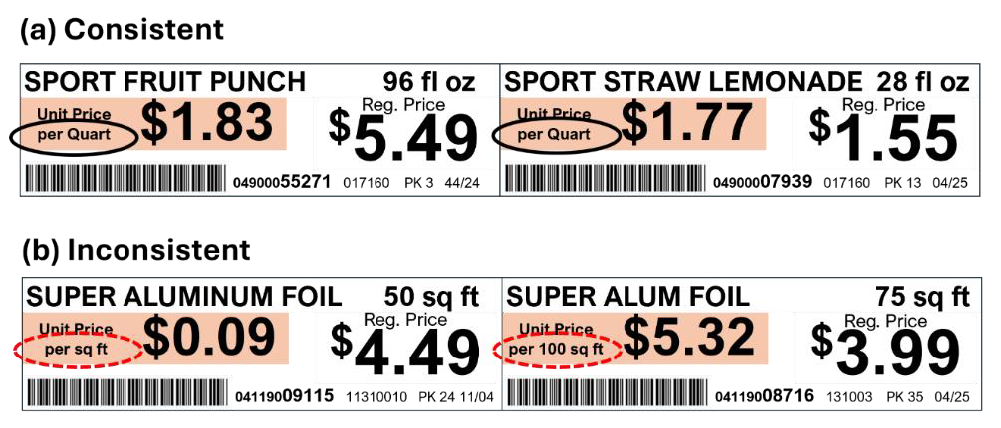
Figure 6 — Examples of (a) consistent units of measure (per quart) and (b) inconsistent units of measure (per sq ft vs. per 100 sq ft) within an individual product category.
Regular and Sale Items
Unit prices should be displayed on all sale signs (e.g., club card promotions, and digital coupon offers) as well as on the regular shelf label (see Figure 7).
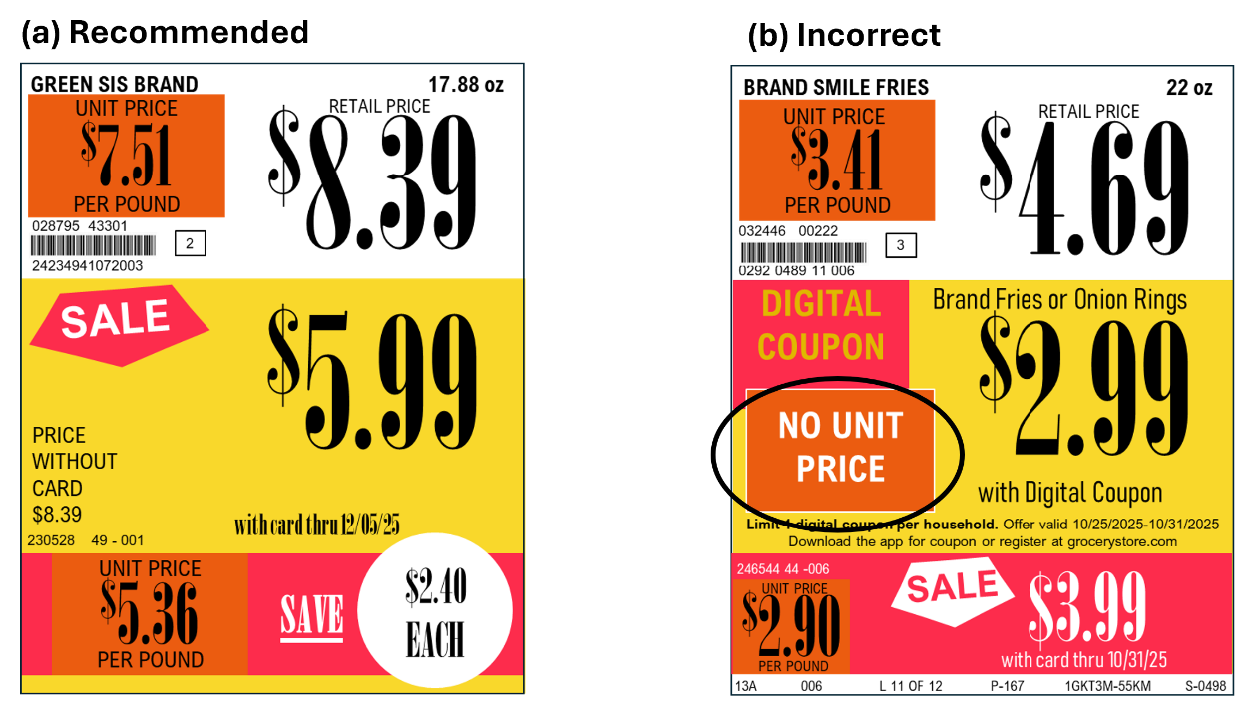
(a) Recommended label design with the unit price displayed for all offers, including the digital coupon option. (b) An incorrect label design that does not have the unit price displayed for the digital coupon offer.
Figure 7 — Examples of sale item price tags with varying unit pricing designs.
Identical Selling and Unit Prices
Even if the retail price and unit price are the same, a unit price should still be provided to maximize consumer use of unit prices and minimize confusion (see Figure 8).
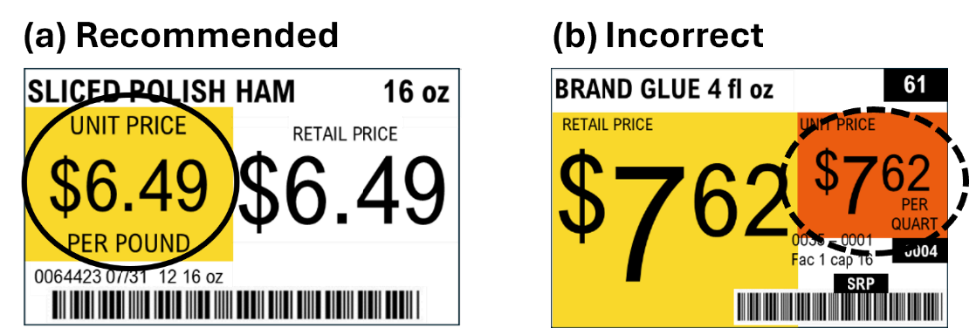
(a) A recommended label design includes the unit price displayed, even though it is the same as the retail price. (b) An incorrect label design for glue where the unit price does not properly reflect the net contents (i.e., 4 fl oz).
Figure 8 — Examples of labels when the retail price is the same as the unit price.
Inclusivity
Unit pricing should be inclusive of all products and across all categories in a store.
Exceptions
An example of an exception to this best practice would include products that can legally be sold by weight or dry volume, such as cherry tomatoes, peppers, and peas. In this case, unit price information will have to be inconsistent across the product category because there is no universal conversion between weight and dry volume.
Section 4. Pricing Methods for Displaying the Unit Price
This section provides guidance on the use of displaying the dollars and cents, acceptable abbreviations, and other best practice recommendations to ensure a clear presentation, format, and usability of this information.
Display of Dollars and Cents
-
The unit price should be to the nearest cent when a dollar or more (e.g., $1.03, $1.49) as illustrated in Figure 9 (a).
-
If the unit price is under a dollar, it should be listed:
-
to the nearest whole cent (e.g., 13¢); or
-
to the nearest tenth of a cent (e.g., 13.1¢).
-
-
Note 1: As illustrated in Figure 9 (b, c), the retail establishment has the choice of using option (b) with the nearest whole cent or (c) with the nearest tenth of a cent for the display of unit prices but should not implement both methods.
-
Note 2: Use of the words “dollar” or “cent” is discouraged.
-
Note 3: The only acceptable symbol for dollars is $, and for cents is ¢.
Linking the Price per Unit to the Actual Unit
The term “per” should be used in all cases when defining the unit price (linking the price to the units). For example, $1.99 per kg or $1.99 per lb, avoid use of symbols such as “/” (e.g., $1.99/kg, $1.99/lb).
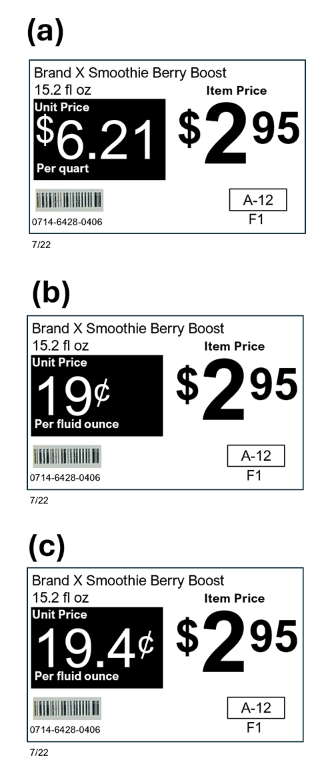
Figure 9 — Three examples (a, b, and c) of label designs and how best to display dollars and cents.
Rounding
The retail establishment should use the same standard method for rounding consistently and accurately when computing prices to the nearest cent. It is advisable to apply standard rounding rules. This means that when the decimal fraction is five (5) or greater, round up (e.g., 13.5¢ would be rounded up to 14¢, and 13.4¢ would be rounded down to 13¢).
Section 5. Presentation of the Unit Price on Shelf Labels and Signs
This section describes where and how unit prices can be displayed for traditional and ESL labels. In all cases, unit pricing information should be clear, prominent, conspicuous, and non-deceptive.
If the commodity is displayed upon a shelf, the unit price label should appear directly below or above the commodity, or alternatively, a unit price tag should be attached to the commodity. If the use of a unit price label or unit price tag is impossible or impractical, a unit price sign or list may be used, provided such sign or list is conspicuously located as close as practical to the commodity.
If the commodity is displayed in a special fashion, such as in an end display, portable rack, or large bin, the unit price tag should be attached to the commodity, or, alternatively, a unit price sign or list shall be conspicuously placed as close as practical to where the commodity is displayed. Nothing in this section prohibits the use of hand-lettered unit price signs on special displays so long as such signs contain the disclosures required above.
If a commodity is refrigerated, the unit price label should be affixed to the case, to a shelf edge, or to the commodity. In the event such attachments are not possible, a unit price sign or list may be used if the sign or list is displayed as close as practical to the articles for sale.
If the commodity is offered or exposed for sale at two or more selling prices (e.g., buy 2 for $2, buy 3 for $1.50), the unit price information relating to such multiple priced items should be calculated and displayed based on each price.
In instances where a store displays a shelf tag or a sign with both the regular price and the sale price of the item, the unit price for each should be displayed with equal prominence near each price.
In cases where a store has multiple prices for the same item, such as a regular price, a "club" price, and/or a price with a digital coupon, the unit price for each should be displayed with equal prominence in close proximity to each price.
Media Used to Display Unit Price
-
Unit price can be affixed to the product or shelf by means of a sign, sticker, stamp, label, or tag.
-
Where a sign is used, that sign should be displayed clearly and in a non-deceptive manner as close as practical to all items to which the sign refers (i.e., if a commodity is refrigerated or in a frozen case, the unit price label could be affixed to the case, case doors, the shelf edge, or attached to the commodity).
-
In e-commerce, sites and advertisements, it is important to ensure that the unit price is located as close as practical to the selling price, as in Section 1. Unit Price Label & Sign Design Principles.
-
Electronic shelf labels (ESL) should follow all the guidelines for unit price and shelf labels, as in Section 1. Unit Price Label & Sign Design Principles.
-
If a single sign or tag includes the unit price information for more than one brand or size of a given commodity, the following information should be provided:
-
The identity and the brand name of the commodity.
-
The quantity (SI or U.S. customary) of the packaged commodity, if more than one package size per brand is displayed.
-
The total retail sales price; and
-
The price per appropriate unit of measure, in accordance with Section 1, Units of Measure for Unit Pricing.
-
Electronic Shelf Labels
-
Electronic Shelf Labels (ESL) are an appropriate and acceptable means of conveying and affixing unit price labels to the shelf for consumers.
-
ESLs should be “always on” and illuminated rather than requiring the shopper to press a button to display the price and/or unit price.
-
All principles and guidance in this section should be applied to the use of ESLs. Retailers and ESL manufacturers should work together to ensure that the best practices of this guide are met. This includes font, text size, font color, and background color. The general principles of displaying unit pricing in a clear, prominent, conspicuous, and non-deceptive manner should be followed.
-
Care should be taken to ensure ESL unit price labels are displayed so that all information can be easily seen and read. Viewing angles can greatly influence the noticeability and readability of information. Therefore, great care should be taken to ensure that labels in difficult viewing situations, for example, lower and upper shelves, are angled to assist the reader. Placing labels at vertical or near vertical positions should be avoided. Care should also be taken to ensure that sign holders and other shelf attachments do not obscure the unit price information. In the case of electronic shelf labels, it is best to choose a type with a wide viewing angle, so that customers viewing labels from the side will see as crisp an image as possible.
In cases where a store utilizes electronic shelf labels, and chooses to display both a regular price and a sale price, or has a two or three-tier pricing system whereby some customers pay one price and others pay a different price, the unit price for each total selling price should be displayed with equal prominence either on the ESL itself or via a combination of the ESL and a paper or plastic price label, dangler, or sign.
Section 6. Presentation of the Unit Price on Signs
The recommendations and guidance in this guide primarily apply to regular retail price and unit price shelf labels. When an item goes on sale, retailers typically attach a “bib,” “dangler,” or hanging sale (e.g., club or card price) tag to the unit (regular) price label, as shown in Figure 10. Additionally, these may include large overhead signs, such as end aisle displays or free-standing displays.
As part of their marketing strategy, some retailers use larger or special signs to draw attention to the regular retail price (not sale price) in locations such as end displays and free-standing displays in aisle promotions. It is recommended that this type of signage include the unit price, even if the item has a unit price displayed in its regular shelf location. In other words, a retailer should include a unit price on any sign, whether sale or regular price, regardless of the location in the store.
Because the size of a sale, bib, or hanging tag is significantly larger than a regular unit price shelf label and because there is no need to repeat certain information already included in the regular unit price shelf label, such as product description and retailer specific information, more flexibility in the displaying of unit pricing information is possible. See also Figure 11 for another example of a sale sign that includes the date of sale and any relevant expiration date of the sale.
These specific guiding principles still apply:
-
The sale sign should be clearly attached, or directly above or under the regular unit price label.
-
The term “sale price,” “as advertised,” “new low price,” “club price,” “temporary price reduction,” or other words of similar import should be stated directly above, in close proximity, or adjacent to the sale price.
-
The term “unit price” should appear in close proximity to or adjacent to the unit price.
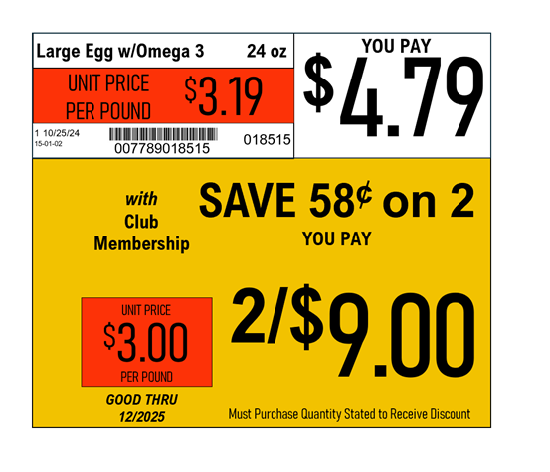
Figure 10 — An example of a hanging “Sale” shelf tag that includes the unit price.
-
To maintain consistency and familiarity, the unit price should appear on the same-colored background as conventional unit price labels.
-
The sale price information should take full advantage of the space available by utilizing a sign rather than a shelf label.
-
The unit pricing information on a sign should take full advantage of the space available. The font size for the sale retail price on a sale sign should be at a minimum of 25.4 mm or 1 in, if it can be reasonably accommodated.
-
The font size of the unit price should be in proportion to the font size of the retail price, but not be less than 50% of the font size of the retail price.
-
All information should be in bold font, prominently displayed, clear, and conspicuous.
-
All rules that apply to regular shelf labels regarding abbreviations, displaying of dollars and cents, defined and acceptable units of measure, and use of “per” apply equally to sale signs.
-
Other relevant information, such as “you save $0.00”, can also be provided, but the font size should not exceed the font size for the unit price displayed.
-
A date expressing the end of the promotion should be provided (e.g., thru Oct 17) and be clear and prominent.
-
Some signs contain tier pricing for multiple items (e.g., buy 1 for $1, buy 2 for $0.75 each). In this case, each scenario on the sign should be unit priced.
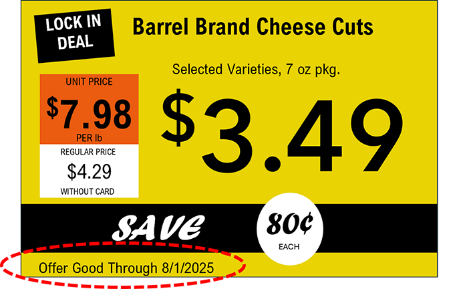
This signage properly displays the unit pricing information of the item on sale and the date of sale, which includes the expiration date of the temporary price.
Figure 11 — An example of a sale sign.
Section 7. Unit Pricing in E Commerce & Advertisements
General
The objectives for unit pricing when a selling price is shown on e-commerce sites and in advertisements are the same as for labels and signs. The unit price information should be easy for consumers to locate and read, displayed in close proximity to the price, and accurate and consistent.
It is particularly important to ensure that the unit price is located as close as practical to the selling price because much more information is displayed on e-commerce sites and in advertisements than on labels and price signs. Figure 12 illustrates an example of unit pricing for products sold via e-commerce, which does not follow the “blocked approach.”
To achieve these objectives, the same principles and methods need to be applied to the unit price for e-commerce and advertisements as they apply in physical stores, insofar as the “blocked approach”. When establishing or maintaining unit pricing in e-commerce or advertisements, special attention should be paid to the following criteria as outlined above in this document:
-
Ensure legibility and prominence.
-
Choose appropriate units of measure and consistently apply them within product categories.
-
Use a consistent method of pricing and rounding.
-
Include unit pricing for all prices offered.
-
Provide unit pricing when the retail and unit prices are identical.
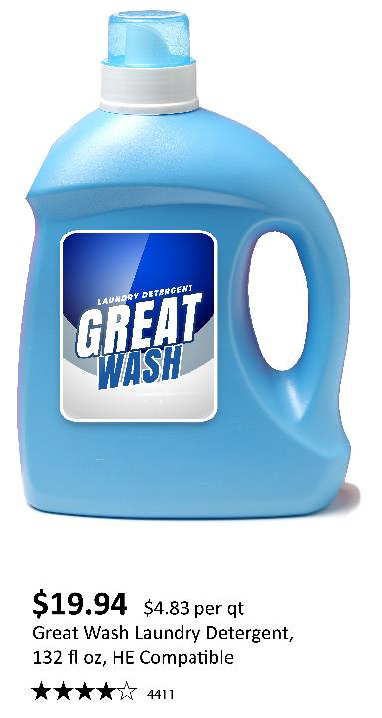
Figure 12 — An example of unit pricing for products sold in E-commerce platforms and applications.
E-Commerce
Consumer products are being purchased through e-commerce sites, whereby the customer makes purchase decisions based on the product information provided on the website, phone application, or other remote means. Because customers make e-commerce purchase decisions based on available information provided on these sites or venues, customers should expect the information provided to be sufficiently complete to make informed purchase decisions and accurate value comparisons.
Therefore, the unit price of the product should appear on the e-commerce site in a conspicuous and prominent location in close proximity to the price, following the best practice “blocked approach”. This information should be provided separately from and in addition to any picture or image of the product and should be in the same units of measure as displayed on the website. The unit price should be consistent with the required method of sale for the product. The responsible party of an e-commerce site should determine the most effective units for ensuring value comparison of similar products with varying product sizes. Unit prices should employ consistent units of measure for similar or competing products posted on the same e-commerce site (e.g., price per ounce, price per inch, etc.)
To assist shoppers when comparing unit prices, a product search function that would allow the shopper to create a list of products for unit price comparison should be considered. This could include a sort feature to allow products/items to be listed in terms of the lowest or highest unit price.
The responsible party of an e-commerce site must remember that the declaration of the unit price of a particular category of product in all package sizes offered for sale in an online establishment should be uniformly and consistently expressed in the same unit of measure.
For more information, E-commerce model regulations can be found in NIST Handbook 1305 Chapter IV, Uniform Regulations Section G, Uniform E-commerce Regulations.
Advertisements in E-Commerce
An advertisement in e-commerce is when an item is offered for sale, discounted, or reduced from its regular price. The following conditions should be met.
-
The term “unit price” should appear directly above the unit price.
-
The sale price information should take full advantage of the space available.
-
The font size of the unit price should be proportional to the font size of the retail price, but it should not be less than 50% of the font size of the retail price.
-
Other relevant information, such as “you save $0.00” can also be provided, but the font size should not exceed the font size for the unit price displayed.
-
Provide a clear and prominent date expressing the end of the promotion (e.g., through Oct 17, 2025).
-
Some signs contain tier pricing for multiple items (e.g., buy 1 for $1, buy 2 for $0.75 each). In this case, each scenario on the sign should be unit priced.
Section 8. General Recommendations and Best Practices
This section provides some practical suggestions and recommendations to help improve the accuracy and usability of unit pricing. Guidance and recommendations are also provided when indicating the unit price on a sign.
-
Audits and checks should exist in any retailer program (similar to price accuracy) to ensure consistent, accurate, and compliant unit pricing, including:
-
Correct calculation of unit price;
-
Correct use of units and abbreviations;
-
Correct and consistent unit price across like items and product categories;
-
All items are unit priced; and
-
Labels affixed to shelves and signage reflect the current price and unit price.
-
-
Retailers should consider having ongoing education programs for consumers to promote awareness and use of unit pricing, with periodic reminder campaigns. Research suggests that even in settings where unit pricing is widespread, consumer usage is enhanced when educational material is provided, and that continual education tends to slowly drop off over time12. Periodic reminder campaigns can be valuable in maintaining usage and ensuring new shoppers are aware of it (e.g., young people learning to shop, people new to the state/country).
-
Unit pricing should be included on any web-based or online pricing.
-
In e-commerce, the unit price should be displayed immediately adjacent to the total selling price and follow all the same guidelines as above.
-
Displaying unit price information should be the goal of any retail business, regardless of store square footage or gross sales, as long as it does not impose an unreasonable burden.
-
Other stockkeeping (retailer-specific) information may also be included at the retail establishment's option, provided that the additional information does not obscure, deemphasize, or confuse the unit price information.
-
Consider the adoption and implementation of digital signage, such as ESL, for efficiency and ease in pricing, unit pricing, price changes, and price history.
-
Consideration should be given to providing larger unit price labels on the bottom shelf and higher labels out of the consumer’s visual reach as compared to unit price labels on easily accessible shelves. This will allow for larger and bolder fonts to be printed for viewing at greater distances, especially for the lower shelves.
Appendix A : Unit Pricing Design Checklist
Design Layout
-
The unit price should be displayed consistently with a color background different from that of the retail price.
-
The minimum height of the unit price should be a minimum of 6 mm or 0.24 in, but no less than 50% of the retail price. Effort should be used to display a font size that will “fill up” the space in the “blocked approach”.
-
Unit Price should have the term “Unit Price” above the numeral(s), and Retail Price should have the term “Retail Price,” “You Pay,” or something similar above the numeral(s).
-
The term “per” should link the numeral unit price to the unit of measure (e.g., $1.00 per lb; $1.00 per 100 sq ft).
-
The product description and size should be prominently displayed.
-
E-commerce and Electronic Shelf Labels shall follow the same guidelines and principles as store labels and signage.
-
Other information (e.g., order code, bar code, etc.) may be included on the label or sign, but only so as not to interfere with or diminish the prominence and clarity of the selling price, unit price, and product description.
-
All information should be clear, prominent, and conspicuous. Consumer information should stand out from retailer information.
-
There should be a space between the quantity and unit in the product identity (e.g., 100 g, not 100g; 3.5 oz, not 3.5oz).
Ongoing Maintenance
-
Determine the correct unit of measure and the price per unit of measure for each item and its category. The unit price measure should be consistent for all products in like categories.
-
Develop automated system checks and audits.
-
Ensure correct symbols and abbreviations are being used.
-
Determine whether rounding will occur to the whole cent or tenth of a cent.
-
Unit pricing should be provided on labels and sale signs.
Other Considerations
-
Retailers should consider an audit program to ensure consistent and accurate item (price) and unit pricing. This includes correct calculations of the unit price, consistent and proper units of measure across like products, and that all products are unit priced.
-
Retailers should consider ongoing education, outreach, and reminder programs for consumers.
Appendix B : Examples of Unit Pricing Labels
The following are illustrative examples intended to demonstrate and highlight common errors on shelf labels and to contrast them with best practice examples. In all the examples, the use of uppercase and lowercase text is preferred but is not required.
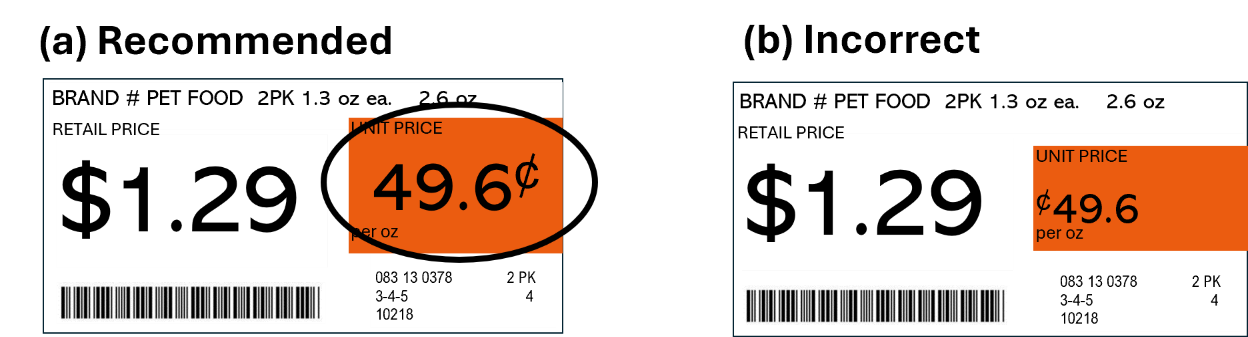
(a) Recommended label includes the unit price with a larger font size (with a minimum of 6 mm). The font size should be at least 50% of the retail price font size. (b) An incorrect example with the unit price font less than 50% of the retail price font size.
Figure B1 — Illustration of the recommended usage of font size in unit price labels.
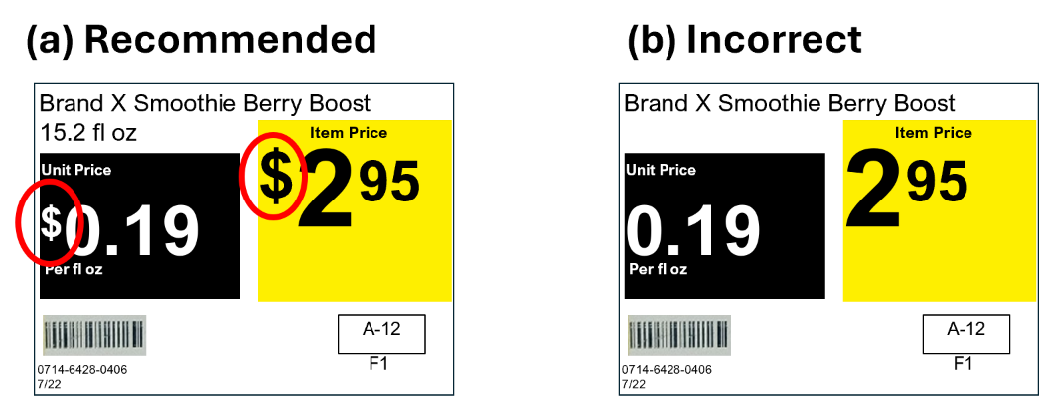
(a) Recommended label includes the dollar sign for both blocks. (b) An incorrect example that does not contain the dollar sign on either price. The size (quantity) should also be displayed in the product description.
Figure B2 — Illustration of the recommended usage of the dollar sign ($) in the retail price and the unit price blocks.
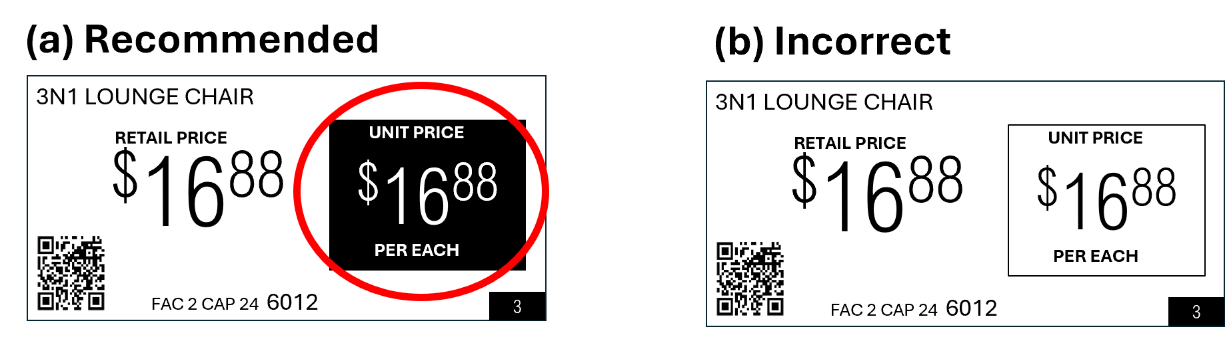
(a) Recommended label includes the unit price block as a different color background from the other blocks. (b) An incorrect example does not contain any contrasting backgrounds.
Figure B3 — Illustration of the recommended usage of contrasting color of the unit price block.
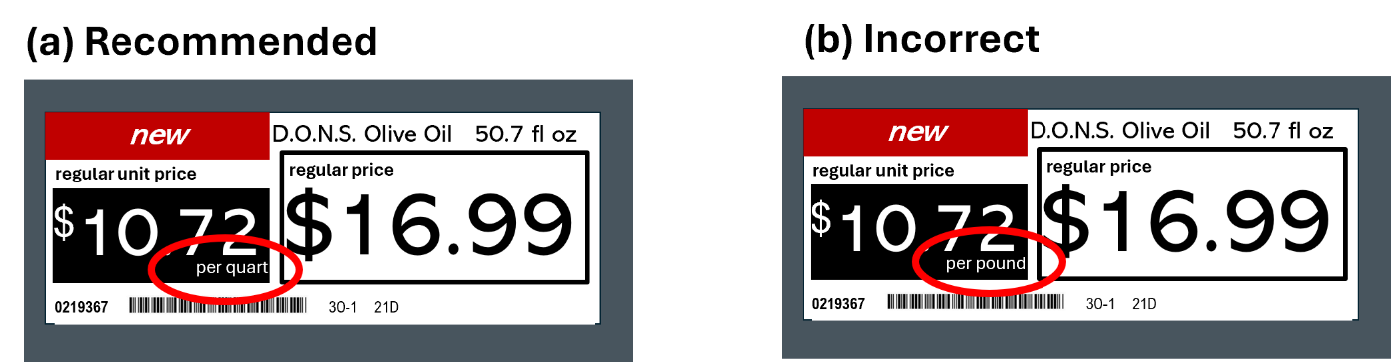
(a) Recommended label includes the unit of measures for the unit pricing in volume (i.e., per quart) that is consistent with the method of sale (i.e., fl oz). (b) An incorrect example has the unit of measure by weight (i.e., per pound) that is inconsistent with the method of sale in volume (i.e., fl oz).
Figure B4 — Illustration of the recommended usage of unit of measure for unit pricing.
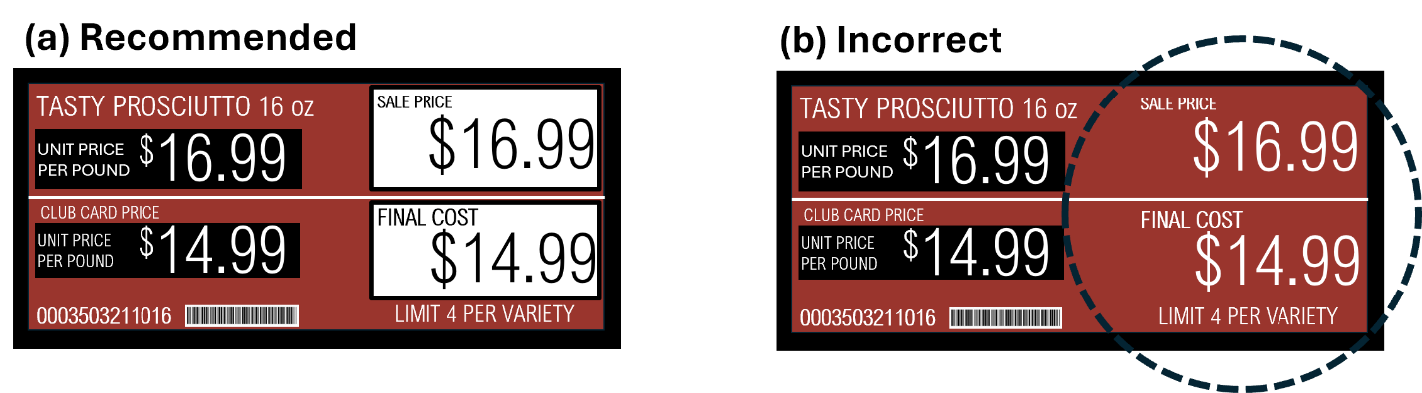
(a) Recommended label adheres to a color contrast ratio of 7:1 or greater requirement20 for all price information on the label. (b) An incorrect example has background with white text and thus fails to meet the color contrast ratio requirement. A red background with black text would also fail this requirement.
Figure B5 — Illustration of the recommended usage of an appropriate color contrast ratio for all label price information.
Appendix C : Examples of Unit Price Signage
The following are illustrative examples of unit price signage currently be used in the marketplace. These include preferred examples together with contrasting, less optimal examples that do not adequately display the information for the consumer. The most impactful action to improve the readability and usability in the unit price labels is to use both a larger font size and the “blocked approach” to clearly distinguish the types of information being conveyed.
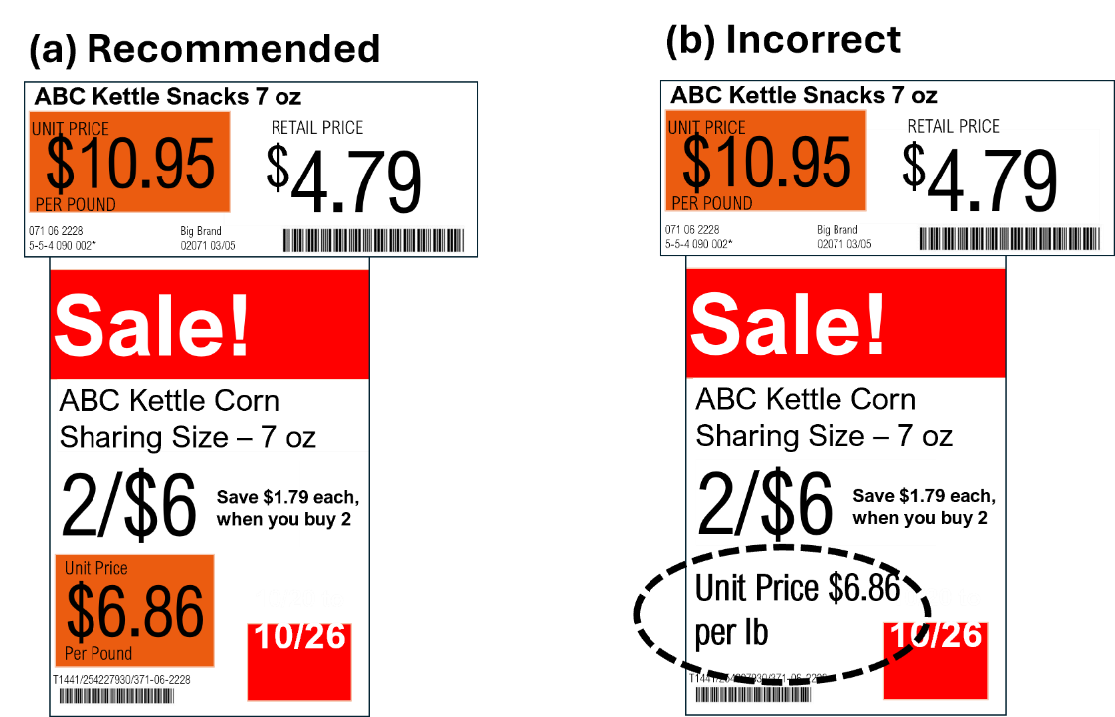
(a) Recommended label includes clearly highlighted and consistent unit price information with an orange-colored box both the shelf label and sales tag and separately from the retail price. (b) An incorrect example has only the shelf label unit price highlighted, thus the unit price for the sales tag is difficult to locate.
Figure C1 — Illustration of unit price information on both the shelf label and the sales tag.
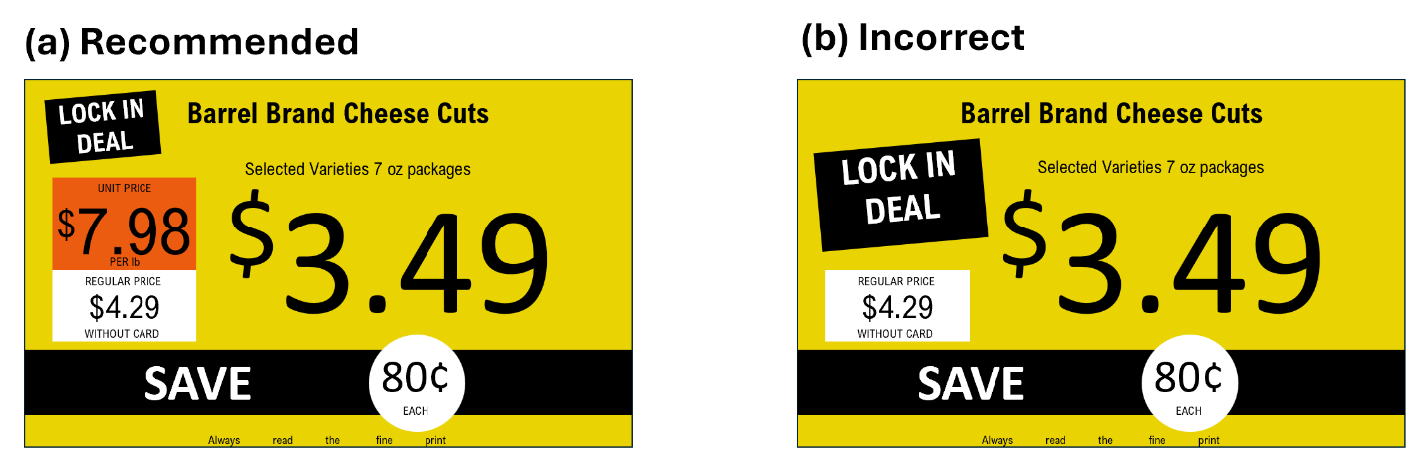
(a) Recommended label includes a clearly highlighted unit price within an orange-colored box. (b) An incorrect example does not include any unit price information for the sale sign.
Figure C2 — Illustration of sale signs that should include unit price information.
Appendix D : Exemptions to the Unit of Measure under the UUPR
The following exemptions, as outlined in NIST Handbook 130 Uniform Unit Pricing Regulation (UUPR), 5 can be made to the unit price. Additional exemptions under state mandatory regulations may apply. These exemptions are optional, not mandatory.
Infant Formula
For “infant formula,” unit price information may be based on the reconstituted volume. “Infant formula” means a food that is represented for special dietary use solely as a food for infants by reason of its simulation of human milk or suitability as a complete or partial substitute for human milk.
Reminder: For infant formula, if the decision is to unit price based on the reconstituted volume, then the unit price must be based on the reconstituted volume and should be consistent and uniform for all infant formula.
Variety and Combination Packages
Variety (e.g., plastic tableware consisting of 4 spoons, 4 knives and 4 forks) and combination packages (e.g., sponge and cleaner, lighter fluid and flints) shall be exempt from these provisions.
-
A variety package is a package intended for retail sale, containing two or more individual packages or units of similar but not identical commodities. Commodities that are generically the same but that differ in weight, measure, volume, appearance, or quality are considered similar but not identical.
-
A combination package is a package intended for retail sale, containing two or more individual packages or units of dissimilar commodities. The declaration of net quantity for a combination package shall contain an expression of weight, volume, measure, or count, a combination thereof, as appropriate, for each individual package or unit, provided the quantity statements for identical packages or units shall be combined.
Note 1: Although technically a store is exempt under these situations under the UUPR, it is the recommendation of this guide that a unit price be provided in all possible situations.
Appendix E : Options to Improve Existing Labels
The following are a series of 12 case studies that include images of labels used in current practice within the marketplace together with a range of example labels that were created using the best practice principles applied from the SP 1181 Guide. Explanations of what is required to improve the readability and usability are also provided.
For the original label in Figure E1, the size, placement, and background color of the unit price do not comply with this best practice guide. Additionally, this label doesn’t follow the “blocked” approach recommendations.
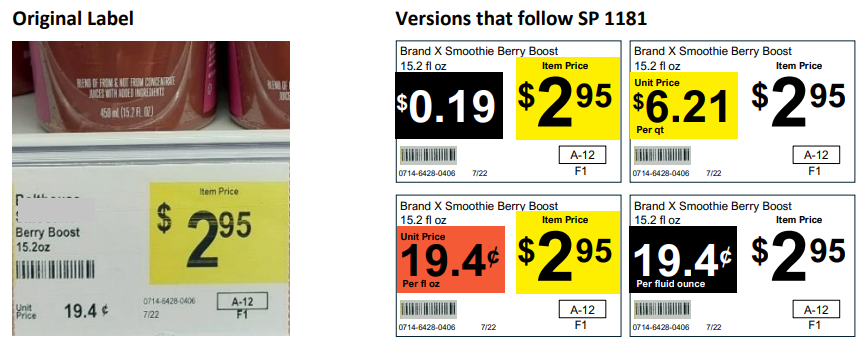
The original label does not comply with the size, placement, and background color of the unit price.
Figure E1 — Example unit price labels for smoothies.
For the original label in Figure E2, the background color should be different for the unit price, not the retail price. Currency signs should be used with all monetary values, and the layout should follow the “blocked” approach.
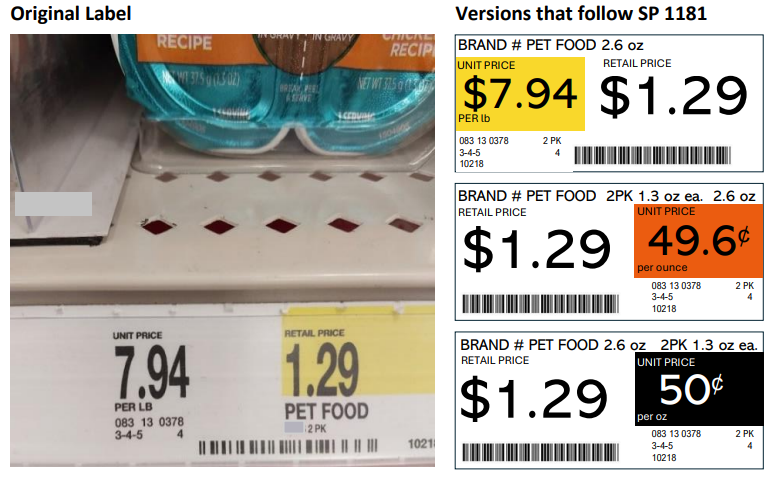
Figure E2 — Example unit price labels for pet food.
The original label does not comply. The background color should be different for the unit price, not the retail price. Currency signs should be used with all monetary values
For the original label in Figure E3, no unit price information is shown, and the label does not follow the “blocked approach” layout.
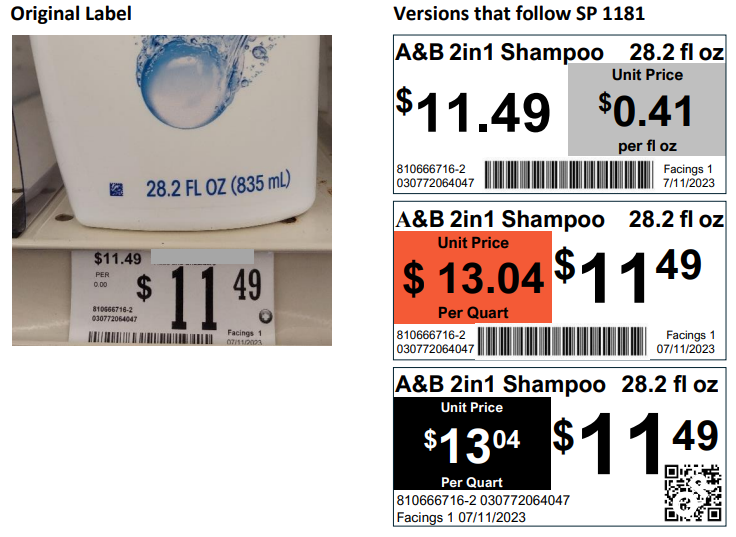
The original label does not comply, as no unit price information is shown.
Figure E3 — Example unit price labels for shampoo.
For the original label in Figure E4, the unit price is incorrect and inconsistent with the unit of measure, and the label should follow the “blocked” approach format, with miscellaneous information below all the other information.
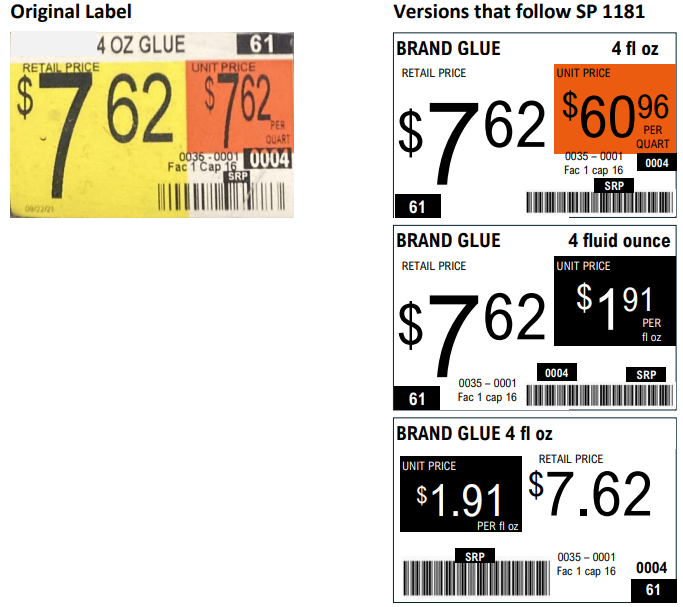
The original label does not comply as the unit price is inconsistent with the unit of measure.
Figure E4 — Example unit price labels for glue.
For the original label in Figure E5, the unit price is missing, and the “blocked” approach format should be followed. Furthermore, certain products, such as yarn, can have multiple methods of sale. The examples in the version that follows SP 1181 reflect the different ways the unit of measure can be displayed; however, the type of units used should be consistent across each product category. (See Section 2. Units of Measure for Unit Pricing.)
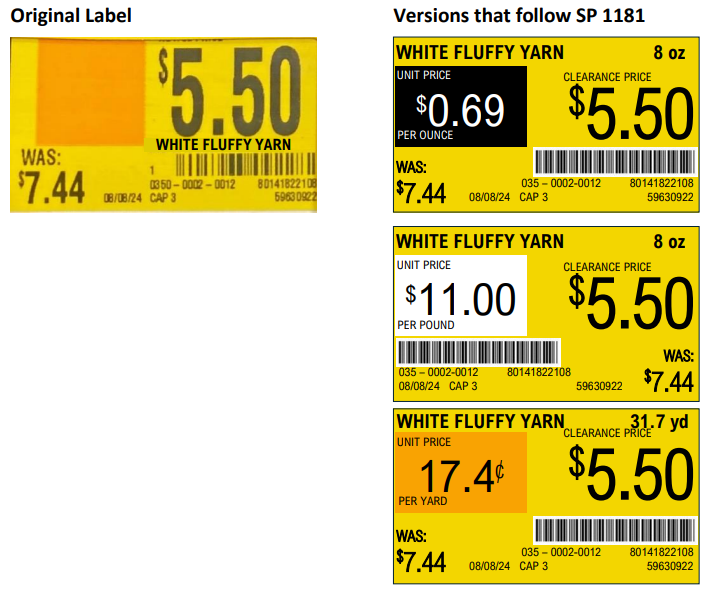
The original label does not comply as the unit price is missing entirely.
Figure E5 — Example unit price labels for yarn.
For the original label in Figure E6, the unit price information should be provided consistently for all retail prices offered and the net content should be included with the product description not below with the miscellaneous information.
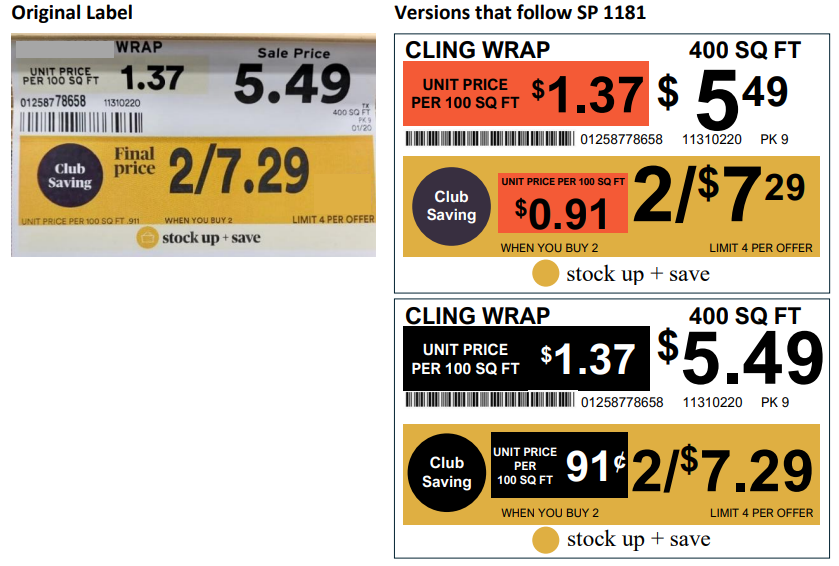
The original label does not comply as the unit price information should be provided consistently for all retail prices offered, and the net content should be included with the product description.
Figure E6 — Example unit price labels for cling wrap.
For the original label in Figure E7, the unit price information should be presented consistently and correctly on both the shelf label and dangling sales label. Currency symbols should be used with all monetary values. The shelf label should follow the “blocked” approach layout with the description above the price information.
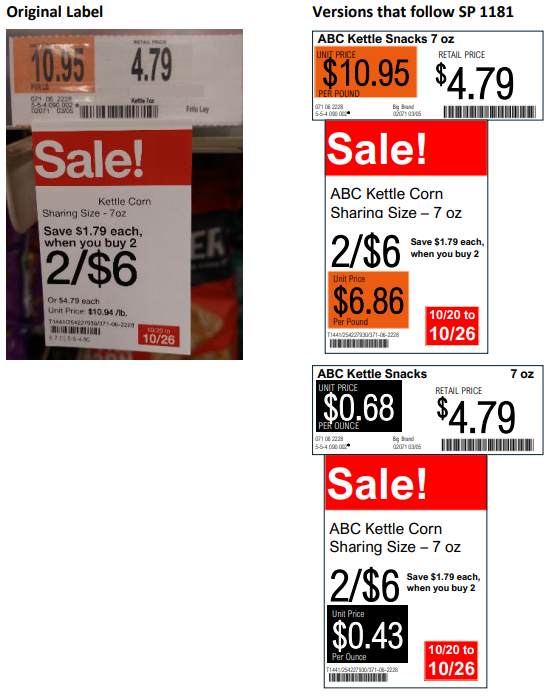
The original label does not comply as the unit price information should be presented consistently and correctly on both the shelf label and dangling sales label. Currency symbols should be used with all monetary values
Figure E7 — Example unit price labels for kettle corn.
For the original label in Figure E8, the shelf label should follow the” Blocked” approach layout, with miscellaneous information below the price information. The unit price information should be provided for all retail prices offered.
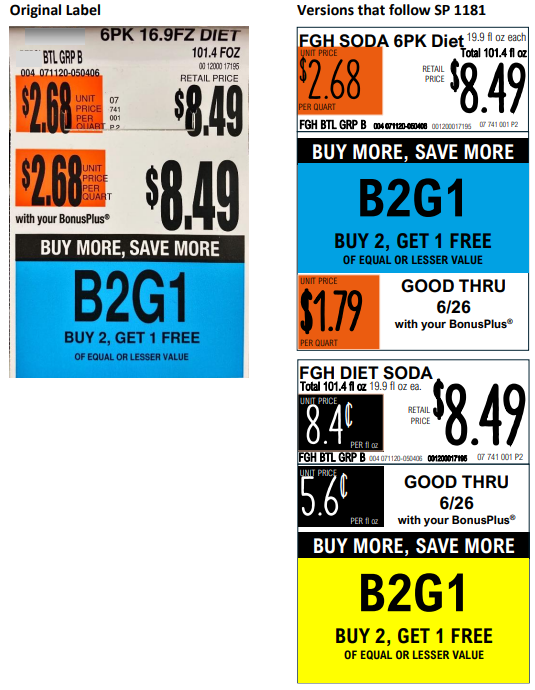
The original label does not comply as the shelf label should follow the “blocked” approach layout, with miscellaneous information below the price information
Figure E8 — Example unit price labels for a 6-pack of soda.
For the original ESL in Figure E9, the unit price information should be provided in a larger font size, and the net content information should be included with the description, not the retail price.
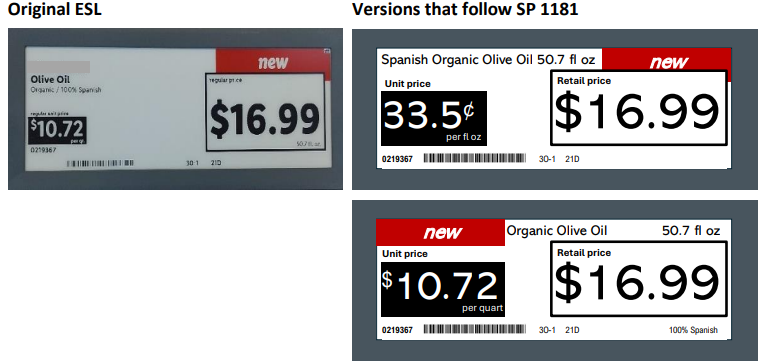
The original label does not comply as the unit price information should be provided in a larger font size, and the net content information should be included with the description, not the retail price.
Figure E9 — Example unit price labels for olive oil.
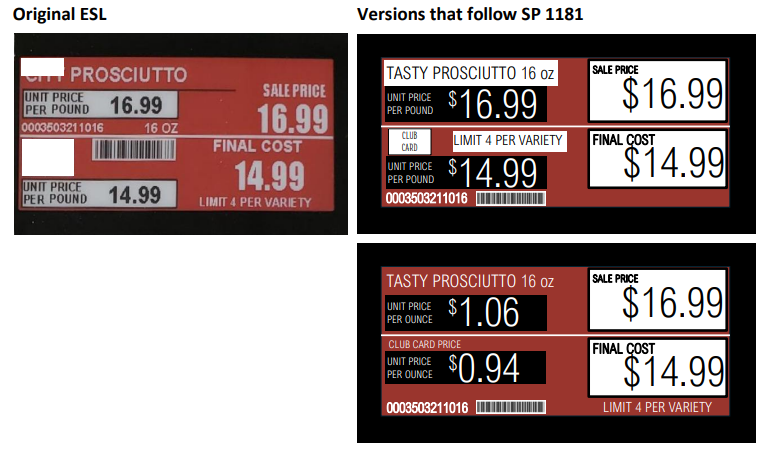
The original label does not comply and should maintain a 7:1 color contrast ratio for all pricing information.
Figure E10 — Example unit price labels for packaged prosciutto.
For the original ESL in Figure E11, the design should follow the “blocked” approach layout with the miscellaneous information below the price information.
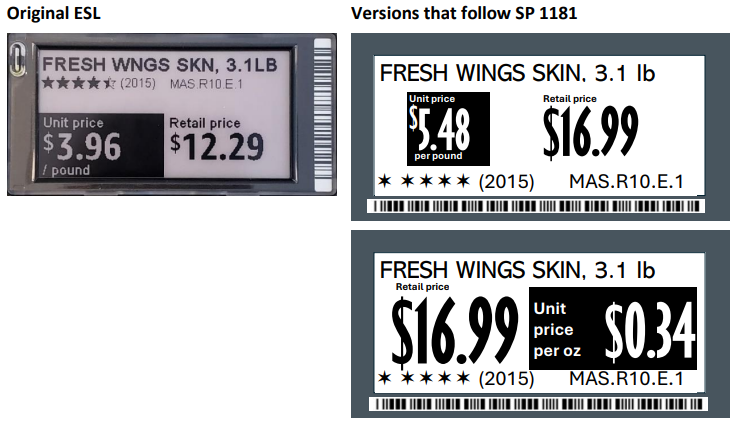
The original label does not comply with the design; the design should follow the “blocked” approach layout, with the miscellaneous information below the price information.
Figure E11 — Example unit price labels for chicken wings.
For the original ESL in Figure E12, the design should follow the “blocked” approach layout with the miscellaneous information below the price information.
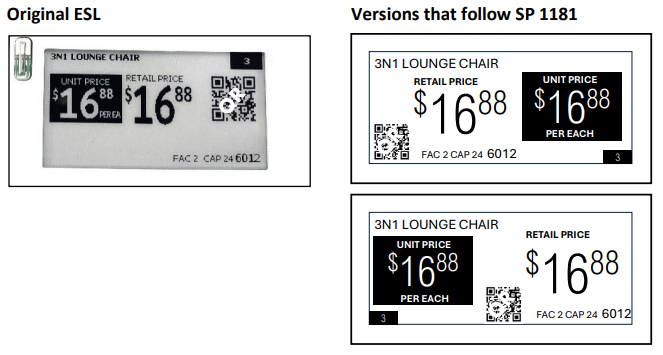
The original label does not comply the design should follow the “blocked” approach layout with the miscellaneous information below the price information.
Figure E12 — Example unit price labels for a lounge chair.
1 Now known as the National Council on Weights and Measures https://www.ncwm.com/
2 Evangelidis, I. (2024). Frontiers: Shrinkflation aversion: When and why product size decreases are seen as more unfair than equivalent price increases. Marketing Science, 43(2), 280-288. https://doi.org/10.1287/mksc.2023.0269
3 FMI The Food Industry Association, https://www.fmi.org/
4 A Guide to Retail Pricing Laws and Regulations, https://www.nist.gov/pml/owm/metrication-law
5 NIST Handbook 130 - “Uniform Laws and Regulations in the areas of legal metrology and engine fuel quality” https://www.nist.gov/pml/owm/nist-handbook-130-current-edition
6 Consumer Reports, http://www.consumerreports.org
7 National Consumers League, http://www.nclnet.org
8 Australian Queensland Consumers Association, a Canadian Report on Unit Pricing, http://option-consommateurs.org/documents/principal/en/File/rapports/commercial_practices/oc_ic_rr_unit_pricing_201010.pdf
9 A Guide to Retail Pricing Laws and Regulations https://www.nist.gov/pml/owm/metrication-law
10 State Weights and Measures Directors https://www.nist.gov/pml/owm/resources-weights-and-measures/state-weights-and-measures-directors
11 NIST Handbook 130, “Uniform Laws and Regulations in the areas of legal metrology and engine fuel quality” https://www.nist.gov/pml/owm/nist-handbook-130-current-edition
12 Evangelidis, I. (2024). Frontiers: Shrinkflation aversion: When and why product size decreases are seen as more unfair than equivalent price increases. Marketing Science, 43(2), 280-288. 10.1287/mksc.2023.0269
13 Mortimer, G., & Weeks, C. S. (2019). How unit price awareness and usage encourage grocery brand switching and expenditure. Journal of Retailing and Consumer Services, 49, 346-356. 10.1016/j.jretconser.2019.04.010
14 Yao, J., & Oppewal, H. (2016). Unit pricing matters more when consumers are under time pressure. European Journal of Marketing, 50(5/6), 1094-1114. 10.1108/EJM-03-2015-0122
15 Roth, S., Himbert, L., & Zielke, S. (2017). Does unit pricing influence store price image dimensions and shopping intentions for retail stores?. European Journal of Marketing, 51(7/8), 1396-1413. 10.1108/EJM-12-2015-0834
16 The Journal of Applied Psychology, Vol XII, NO 4, “Influence of Type Form on Speed of Reading”, Miles A. Tinker and Donald G. Paterson
17 New York: Harper and Brothers 1989, 24 VOL. 9, NO.1 “How to make Type Readable”, Paterson, D.G. and Tinker, M.A.
18 McAlister, Anna R., Soo Kim, and Chen Lou (2013, May). Design Elements in Unit Price Labels Influence Consumers’ Information Processing Abilities. Special session paper presented at Marketing and Public Policy Conference, Washington, DC.
19 Study by Svetlana Bogomolova and Justin Cohen. (Ehrenberg-Bass Institute for Marketing Science, University of South Australia), Harmen Oppewal (Monash University), and Jordan Louviere (Institute for Choice, University of South Australia), February, 2014
20 WCAG 2 Overview | Web Accessibility Initiative (WAI) | W3C